



“Survival of Kindness” Q&A – The Journey, Not the Destination
©2026 TIFF
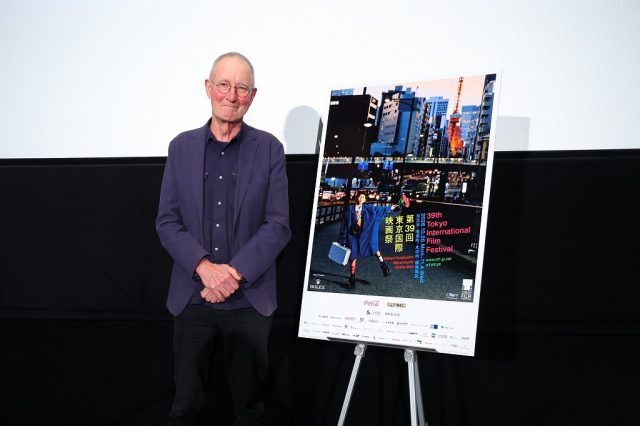
Australia-based writer, director and producer Rolf de Heer, who is also serving as president of the 39th Tokyo International Film Festival’s Competition Jury, was in attendance at a screening of his most recent film, The Survival of Kindness, as part of the festival’s World Focus section. The film, which won the FIPRESCI Prize at the 2023 Berlinale, is an almost entirely dialogue-free experience. Set in a post-apocalyptic world, it opens as BlackWoman is abandoned in a cage in the middle of a desert by a group of strangers in masked strangers. As she escapes, she journeys through mountains and wilderness before reaching a city, where other oppressed figures like BrownGirl and BrownBoy seek to survive by hiding from a society in which these masked figures enslave minority people.
It’s a film very much in line with the director’s broader filmography, which has often tackled colonialism, race, Aboriginal issues in Australia and more. However, the film’s story came from very different roots than many of his other works, and he has taken a very different creative approach, making it feel quite experimental.
Speaking with the audience during the Q&A session on November 2, de Heer explained, “The genesis of the film was that I was working on a screenplay with the hope of receiving funding and it seemed like I had found that funding successfully. But then Covid-19 came and everything collapsed, and while that was happening, I began to understand that things would not be the same.
“I needed to rewrite this project, which I tried to do, but it didn’t work. So I had to find a new way to make a film. I live in Tasmania in the southern part of Australia, and I thought, what am I going to do? So I thought I would go look at the mountain that I live near but had never explored. I looked at it to see if anything came to me. I found some locations that were interesting and the initial project became something called The Mountain.”
It was from there, one day, that the image of Peter Djigirr, an Aboriginal actor and close friend of de Heer, locked in a cage in a desert to die came to him, and the story developed from that.
The director was writing the film at a time when widespread protests and discussion about people’s rights were taking place, including the Black Lives Matter movement. Though he considered these ideas closely while developing the latter parts of the script to bring meaning to his story, he generally tries to avoid what he calls any “over-intellectualizing,” that could get in the way of creating a journey and story.
“When I write, I strenuously resist thinking about characters, story arcs, the three-act structure, anything to do with themes, and the reason is simple,” de Heer stated. “I will try to write something, and it will either feel right or it will feel wrong. It will feel good, or it will feel bad. I know my brain is doing a lot of things, but not at the surface.”
The Survival of Kindness is notable for its relative lack of dialogue, but this was not always meant to be the case. The story as it was developed followed the journey de Heer had imagined, but he often found that when he added dialogue to certain scenes, the impact of a moment could be lost. Eventually, the scenes without dialogue felt more natural, and before he knew it, these would be the better scenes. Indeed, the only time there is what could be referred to as spoken language is toward the end, in a “conversation” between the native languages of the Congo-born actress Mwajemi Hussain, who plays BlackWoman and Nepalese-born actress Deepthi Sharma, who plays BrownGirl.
“Their dialogue was not written as a conversation,” de Heer said. “BlackWoman says something that BrownGirl does not understand, then BrownGirl says something that BlackWoman does not understand. And we understand neither of them. The language is meant to be what I call gobbledygook.”
In response to an audience question, the director added, “I worked on this script in an unusual way, which was to plan the journey geographically, see what locations I would find, and see what those places would give me in terms of what a scene could be. So I had the cage and location there, and then I found locations that followed it. The first location the story demanded was, there was someone with a gun and they would steal their boots and things like that. So I tried to write that scene with dialogue and I couldn’t make it work. And it was only when I had the idea that they couldn’t understand each other that it began to work.”
The Survival of Kindness is thus a story about people who don’t understand each other, and a mythical journey through a land that reflects this lack of understanding. As the saying goes, the journey is more important than the destination.
World Focus: The Survival of Kindness
Q&A Guest: Rolf de Heer (Director/Screenplay/Producer)
Profile of Rolf de Heer
Press Conference by International Competition Jury Members on Oct 27 – Festival Ranking Matters Less than the Power of a Film to Move Viewers














Recent News