


“Okinawa Saudade” Q&A – A Search for Ancestral Roots
©2026 TIFF
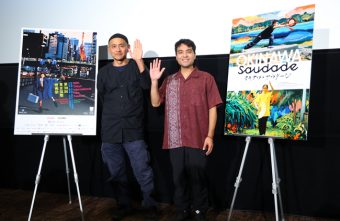
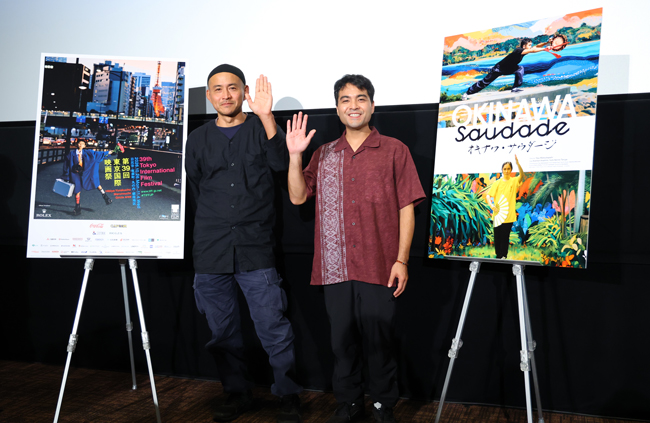
From left: Matsubayashi Yoju (Director) and Arashiro Everton (Cast)
From left: Matsubayashi Yoju (Director) and Arashiro Everton (Cast)
Matsubayashi Yoju has established himself as a distinctive Japanese documentarian who explores the complicated notion of Japanese identity. His latest film, Okinawa Saudade, was selected for the Nippon Cinema Now section of the 39th Tokyo International Film Festival and had its world premiere screening on October 31, after which the director and one of his subjects, Arashiro Everton, joined a Q&A session.
From Flowers and Troops (2009), which focuses on former Japanese soldiers who remained in Southeast Asia after the war, to Okinawa Santos (2020), about the deportation of Japanese immigrants in Santos, Brazil, during World War II, Matsubayashi has directed his camera toward Japanese migrants who have an ambivalent relationship with their roots.
Okinawa Saudade features two descendants of Okinawan immigrants to Brazil, Teruya Celine Yumi and Arashiro Everton, both of whom are trying to preserve Okinawan culture in Brazil. The documentary follows them on their journeys to Okinawa to meet their distant relatives and learn about the history and culture of their ancestral homeland. As a result, this spiritual sequel to Okinawa Santos presents a more hopeful view than its predecessor, suggesting that a harmonious relationship between two cultures is still possible and essential in today’s turbulent world.
Programming Director Ichiyama Shozo, moderating the Q&A session, asked Matsubayashi about his decision to make another film about Okinawa, and he explained that it came to his mind in 2016, when he saw a group of students of Okinawan descent performing traditional dances at a festival in Brazil. “I went to talk to them and they told me that they had met their relatives in Okinawa,” said the director. “When they saw Okinawa for the first time from the airplane, for some reason they couldn’t stop crying. When I heard that, I had to make a movie out of it.”
Despite the difficulty in getting enough support to realize his project, an opportunity arose for Matsubayashi two years ago when the Brazilian government officially apologized to Okinawan immigrants on July 25, 2024, for its wartime persecution of Japanese immigrants including the forced removal of Japanese residents from Santos, the subject of Matsubayashi’s Okinawa Santos. “After that happened, I was invited to Brazil again,” he recalled. “Taking the opportunity, I was hoping I could make this movie about finding roots. [The Urizun Association] gave me the list of people [I could interview], probably about 10 people, but from the first moment, they were recommending two of them [Teruya Celine Yumi and Arashiro Everton].”
He continued, “The good thing is that a relative of Everton’s was involved in the Santos incident. So they were really cooperating with me to interview them. Since we got the official apology from the Brazilian government, many generations, young and old, when they see me, they say, `I watched your film.’ So it was easy both in Brazil and in Okinawa to do the shooting.”
For Arashiro, accepting the director’s offer to be one of the subjects of the film was an easy decision to make. He said, “I saw a very important opportunity because with this project, my family in Brazil can watch the whole journey in Okinawa, meeting my family and my relatives there.”
That “whole journey” of visiting Okinawa and making a film out of it meant much more than Arashiro originally imagined. He explained, “I went to Okinawa to learn more about my family and history. But I found much more than information about my ancestors. I met people, discovered places connected to my family, and heard stories that changed the way I understand my own identity.”
The director revealed that originally, “saudade” was a reference to Tomita Katsuya’s Saudade (2011), which focuses on the problems of identity and social discontent among the rootless youths in Kofu, Japan. With the completion of the film, however, the Portuguese word, which refers to the longing for someone or something far away, takes on a deeper meaning for Arashiro. “During the experience in Okinawa, saudade also came to mean the desire to reconnect, visit places, and rebuild relationships,” said Arashiro. “I realized that our roots are not just something we search for in the past; they are also present in the relationships we feel today.”
Nippon Cinema Now: Okinawa Saudade
Q&A Guests: Matsubayashi Yoju (Director) and Arashiro Everton (Cast)















Recent News