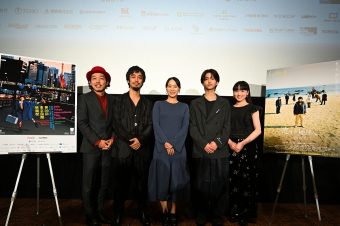



“My Wife Cries” Q&A – Life Outside the Ellipsis
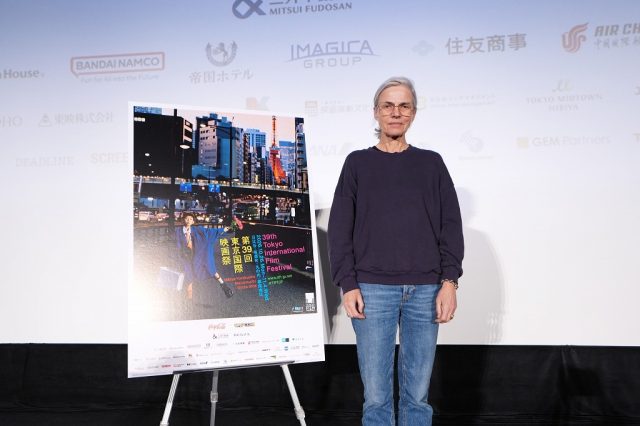
©2026 TIFF
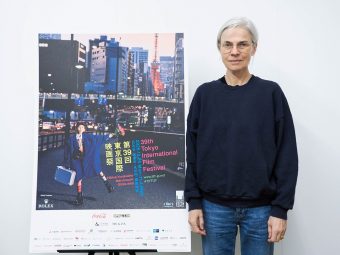
Angela Schanelec screened her new work, My Wife Cries, as part of the World Focus section at the 39th Tokyo International Film Festival on October 29, then joined the audience for a Q&A session. The German-French coproduction tells a deceptively simple story but in an elliptical way—a style that has earned her critical acclaim and a pair of Silver Bears at the Berlin International Film Festival.
The central event in My Wife Cries is a traffic accident that happens offscreen, involving Carla (Agathe Bonitzer) and the man she is having an affair with, who is killed in the accident. However, this information is only revealed in a remarkable confession that Carla makes to her husband, Thomas (Vladimir Vulevic), as they walk along a city sidewalk at night while Carla pushes her bicycle. By the end of Carla’s long monologue, which is pointedly meant to hurt Thomas, he is so inconsolable that he collapses and has to be hospitalized. The remainder of the film touches on the consequences of Carla’s infidelity obliquely, while also introducing the couple’s acquaintances and exploring their own relationship problems.
The Q&A moderator, Shibutani Tetsuya, Professor at College of Humanities and Sciences, Nihon University, commented that Schanelec’s last film, Music (2023), which was also screened at TIFF, had very little dialogue, while My Wife Cries has a lot of it.
He also noted that the natural rhythms the director incorporates in her lines often make the conversations sound like music, which must have been time-consuming since the two lead actors are not fluent German speakers.
“We did a lot of rehearsals,” Schanelec replied. “In fact, it was more like a training session than a rehearsal. I worked with Vladimir for a year, just repeating the lines over and over, until he learned them as if they were a part of his body. It was more like a sport. Agathe joined six months later, so she only had to train six months.”
It’s clear that Schanelec is a stickler for preparation, from the strictly scripted dialogue to the blocking. One audience member, who claimed to have seen “98 percent of your work,” asked how much room there was on set for improvisation.
“There is no room for improvisation,” said Schanelec. “The actors say exactly what is written, which isn’t to say that they aren’t present in the scene. It just means that the actor knows what he has to say, he doesn’t have to think. He has to be there in the moment, because I already took care of the words.”
The same seems to go for any changes along the way. Schanelec said that she only changes things if, for instance, an idea doesn’t work at a location she’s selected. “I can’t plan for the weather,” she said, “and in the editing, sometimes I understand better what I want to say than when I wrote the scene.”
Because of the film’s oblique narrative style, there are some scenes that come across as non sequiturs. In one, a group of friends is assembled at a house discussing in poetic terms the vicissitudes of love when they spontaneously start dancing to Leonard Cohen’s “Lover Lover Lover.”
A viewer asked if the dance was choreographed, adding that he couldn’t imagine a person like Schanelec “moving that way,” a comment that made the director laugh out loud.
“There was no choreographer,” she said. “We did rehearsals, and the moves the actors came up with were moves they thought their characters would make, meaning they’re the only people who can come up with those moves. Then they worked together to coordinate it all. It was not a big thing.”
Another viewer commented in English that Schanelec’s films all play to a “specific milieu, which is bourgeois and European.” The director denied that she was depicting or targeting a particular audience. [mw1.1]Her movie, she said, “is about humanity, and not specifically about bourgeois intellectuals.” In the case of My Wife Cries, the comment was especially puzzling since the protagonist couple, Carla and Thomas, are not only working class—the husband a crane operator, the wife a daycare worker—but neither character is a native German speaker, as evidenced by their noticeable accents (and as discussed by the director in response to an earlier question in the session).
The exchange highlighted Schanelec’s cinematically unconventional methodology, which some critics have termed difficult, since it does not trade in chronologically laid-out stories with dramatic peaks and valleys. But Schanelec, who has written and directed a dozen features, is famous for these elliptical narratives, as she deserves to be.
World Focus: My Wife Cries
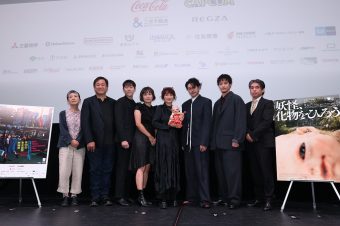
Q&A Guest: Angela Schanelec (Director/Screenplay/Editor)
For further insights into her distinctive approach to filmmaking and the challenges of reaching international audiences, read our exclusive interview with Angela Schanelec, conducted during the 39th TIFF.
Related Article: Angela Schanelec and the Consequences of Everyday Life — An Exclusive Interview














Recent News