


“Plastic Love” Q&A – Unwrapping a Sticky Issue
© 2026 TIFF
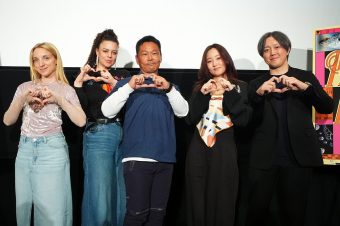
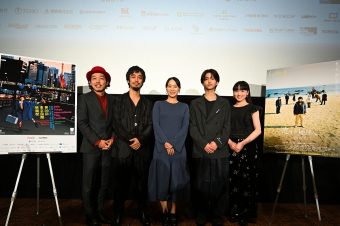
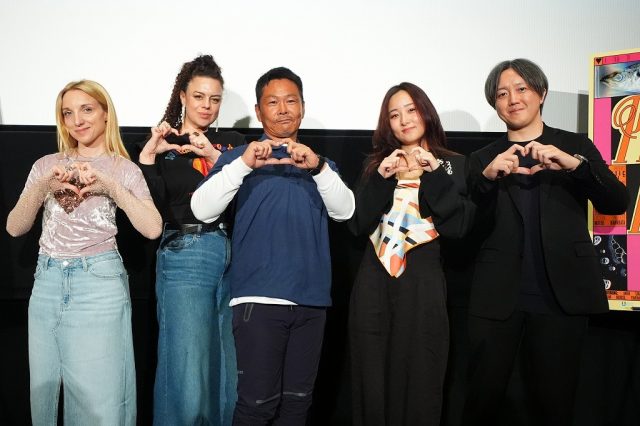
From left: Sybilla Patrizia (Director), Clementine Nuttall (Director), Sato Taisuke (Cast), Ide Mariko (Editor), Kato Hisaki (Composer)
From left: Sybilla Patrizia (Director), Clementine Nuttall (Director), Sato Taisuke (Cast), Ide Mariko (Editor), Kato Hisaki (Composer)
The Tokyo International Film Festival’s Nippon Cinema Now section has always boasted a diverse selection, and that was certainly evident on October 30 with the world premiere of the call-to-action documentary Plastic Love!, centering on Japan’s addiction to disposability. The peppy title and the film’s nonpreachy approach belie its subject, but it is nominally about the human propensity for overconsumption and the inevitable nonbiodegradable trash that is clogging our oceans and threatening our way of life. Noting that it had taken seven long years to complete and that over 100 people had been involved in the process, onscreen and off—for whom they thanked effusively—codirectors Sybilla Patrizia and Clementine Nuttall joined editor Ide Mariko, composer Kato Hisaki and cast member Sato Taisuke at the front of the theater for a post-screening Q&A session.
Plastic Love! is not your grandparents’ staid, scolding documentary about the dire state of garbage. Yes, it provides important facts and figures (plastic waste could triple in the next 25 years), but it also offers a wide-ranging meditation on why and how Japan wound up as the world’s second-largest user of single-use plastic, when it had been so long admired for its almost-mythical connection to traditional materials and their use. Taking an exceptionally appealing visual approach to the issue (Patrizia is an accomplished cinematographer and deploys her practiced eye to interesting effect), the film interweaves stories and interviews with Japan’s waste workers, packaging artisans, activists and ordinary citizens, illuminating a nation caught between “the wisdom of its past and its culture of excess” (as the official synopsis so aptly puts it).
While care for materials still exists, Japan has certainly come to embody the global waste paradox. Endless vending machines (even at the summit of Mt. Fuji!) sell millions of varied PET bottles, department stores quadruple-wrap each food purchase, and yet the garbage trucks are adorned with friendly mascots and some municipalities have identified 45 categories for sorting, to aid in recycling and reuse. In Japan, trash and care for materials do coexist. But Plastic Love! makes the urgent point that the cycle of wastefulness must and can be broken. One interviewee laments, “When I was young, we used lacquerware. Were humans so afraid of decay that we created a material that could live forever?”
During the Q&A session, the film’s editor hinted at where the title came from: “There’s a saying, ‘Where there’s a will, there’s a way,’” said Ide. “But while I was editing this film, I became convinced that there’s another way to put it: ‘Where there’s love, there’s a way.’ Seeing all of you here on a weekday afternoon, taking the time to watch this film, makes me feel that love very strongly. I’m really happy and grateful that you’re here. Thank you!”
(Co-director Nuttall later admitted that the team had listened constantly to the 1985 single “Plastic Love” by Takeuchi Mariya.)
Composer Kato Hisaki told the audience, “Starting with Sybilla and Clementine, so many people involved in this film brought an extraordinary amount of passion to the project. Being exposed to their dedication and commitment was deeply inspiring. When I worked on the music, I felt a tremendous sense of responsibility. Their passion made me approach the work with a great deal of seriousness and humility.”
Sato, who works in waste disposal for the city of Zama, explained, “There are limits to what we can ask residents to do. We can only make requests. We can say, ‘Please do this,’ but we can’t force people to change their behavior. As I mentioned in the film, garbage has a very negative image. People think of it as dirty or smelly. I’ve always disliked those associations.
“If children grow up thinking of garbage only as something dirty, unpleasant, or disgusting, I don’t believe environmental issues will ever really register with them. They won’t become interested in learning about the problems or thinking about what they can do. So the staff at our Clean Center began developing activities and educational materials that children could enjoy. One of the things we do is create art using plastic bottle caps. We make colorful, cheerful cap art that brings smiles to people’s faces when they see it. We’ve developed many different kinds of activities like this to connect with children and help them develop an interest in environmental issues.”
Sato also mentioned efforts to get people to reuse rather than just tossing unused items: “Instead of sending everything we no longer need straight to the incinerator, I believe it’s important to find another route for those objects, another path they can follow. With that idea in mind, we started an initiative involving children’s clothing. The idea is very simple: When a child has outgrown an item of clothing, or a family no longer needs it, we try to pass it along to another child who can still use it.
“I think there’s something very heartfelt about that process. It’s not just about getting rid of unwanted belongings. It’s about recognizing that something still has value and making sure that value can be passed on to another person. That’s the spirit I want to preserve as we continue developing the initiative.”
An audience member mentioned that she had tried to imagine Japan without plastic, but couldn’t. “Companies need to manufacture products, and they often need to package those products in plastic in order to sell them,” she said. “They also need to produce large quantities to stay in business. If they stop producing or packaging things in the way they do now, they may not be able to survive financially.
“But at some point, we have to stop this cycle. I think that’s one of the things the film was trying to show us. What I keep wondering is how we can actually make that happen. How can we stop it? How can we persuade companies and the people who manufacture and sell these products to change the way they operate? After spending seven years making this film and exploring these issues, have you arrived at any answers or ideas about how we can bring about that kind of change?”
Patrizia responded, “I think one of the things I realized over these seven years is that, for me at least, this film isn’t actually about plastic. I think it’s about our connection to the world around us, and about how we’ve lost our connection to the things we touch and use every day.
“When we talk about how to solve these problems in society, we often focus on questions such as how we can recycle more or how we can clean up the trash that’s already out there. Of course, those things are extremely important. We absolutely need to keep doing them. But before we get to that stage, I think there’s an even more important question: How can we prevent new waste from being created in the first place? How can we stop things from becoming trash before they even reach the point where they need to be recycled or cleaned up?”
Emphasizing that it’s a challenge affecting the entire world, she continued, “We wanted to [take a step back and] look at the extraordinary amount of time involved in the creation, use and disposal of the things we touch every single day. How many hands have those things passed through? How many years did it take for them to come into existence? What happens to them after we throw them away?
“When you begin to see how many people are involved in all these different stages, you also realize that the issue of plastic waste isn’t actually just one issue. There’s microplastic pollution. There are concerns about human health. There’s environmental pollution, including pollution in the oceans.
These are different problems, and each of them requires its own specific solutions.
“I don’t think there’s one answer that can solve everything at once. But I do think there’s something each of us can take away from this discussion. Rather than looking at this enormous problem and feeling that we somehow have to solve the whole thing ourselves, I think it’s important to break it down into smaller problems and smaller solutions. There are things every one of us can do.
I think breaking the issue down into a much smaller scale and making it something that feels achievable in your own life, is really important. [You can] look at the people around you, the things you use, the work you do, and the community you belong to, [and make] smaller changes, like choosing to reuse rather than disposing of an object. Otherwise, the problem can become so overwhelming that you feel you have to find a solution to everything, and that’s simply too much for one person.”
Nippon Cinema Now: Plastic Love!
Q&A Guests: Sybilla Patrizia (Director), Clementine Nuttall (Director), Sato Taisuke (Cast), Ide Mariko (Editor), Kato Hisaki (Composer)










Recent News