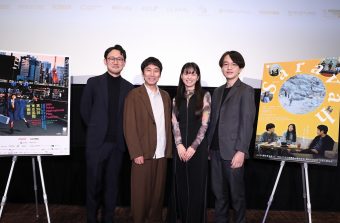



“Fuxi: Four Tales of Feasting Celebrating” Q&A – Simple Joys in Elaborate Settings
© 2026 TIFF
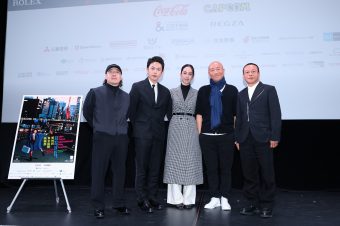
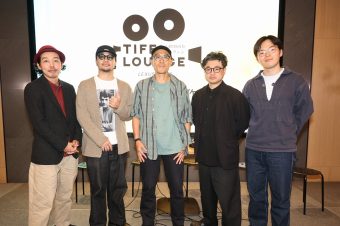
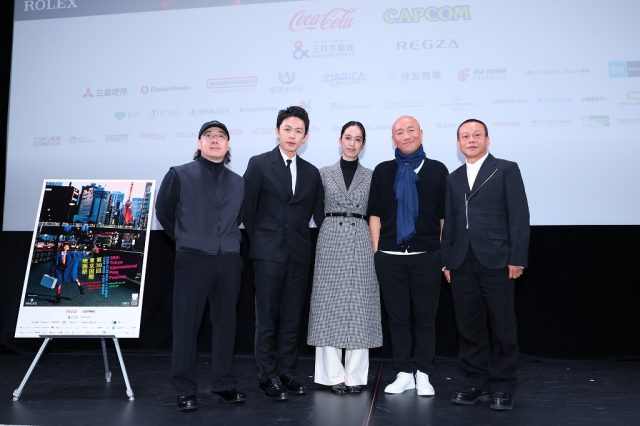
From left: Wang Hai (Actor), Lee Hong-chi (Actor), Annie Chen (Actor), Qiu Jiongjiong (Director/Screenplay/Production Desginer) and Lee Kang-sheng (Actor)
From left: Wang Hai (Actor), Lee Hong-chi (Actor), Annie Chen (Actor), Qiu Jiongjiong (Director/Screenplay/Production Desginer) and Lee Kang-sheng (Actor)
Qiu Jiongjiong’s tour-de-force visual smorgasbord Fuxi: Four Tales of Feasting enjoyed its world premiere in the 39th Tokyo International Film Festival’s Competition section on October 29, and if the audience’s reaction is any indication, Sichuan’s “fuxi” may soon be as well-known a culinary concept as Japan’s “washoku.” The writer-director-production designer took the stage after the screening, amid heavy applause from the sellout crowd, along with actors Lee Kang-sheng, Lee Hong-chi, Annie Chen and Wang Hai, to discuss the film.
Credited as a Hong Kong/Taiwan/Japan/Saudi Arabia/Qatar coproduction, Fuxi is entirely in the Sichuan dialect—the title combines the characters for “belly” (fu) and “joy” (xi)—and is inspired by Sichuan’s myths, folklore and tradition of strange tales. Unfolding across four millennia, its four feasts bring together the living and the dead, gods and demons, animal spirits and deposed leaders, seating them together at the same table, where mouth-watering recipes and much more are shared, along with the pleasures of eating amid life’s hardships and uncertainties. From an ancient ancestor’s funeral to a king’s spring rite, from an exiled poet’s banquet to an orphan boy’s birthday, each tale savors the everyday joy of food.
Qiu, best known internationally for A New Old Play (2021), winner of the Special Jury Prize at the 2021 Locarno Film Festival, creates a singular handcrafted cinematic universe that unites painting, poetry, theater and film in ways that evoke Méliès (A Trip to the Moon (1902) is obviously an inspiration here) and Greenaway (ditto The Cook, the Thief, His Wife & Her Lover (1989)). The sumptuous, fantastical Fuxi was shot entirely in a studio, on sets derived from some 1,000 storyboards that Qiu generated.
Moderated by TIFF Programming Director Ichiyama Shozo, the Q&A session began with a question about the director’s inspiration for the film. “I began writing the screenplay in 2022, during the Covid pandemic, when lockdowns were being imposed everywhere,” recalled Qiu. “During that time, I noticed how strongly people longed to go outside, gather with others, and share a meal. That desire to eat together was what first inspired me to write the screenplay.
“You may be familiar with [A New Old Play], which focused more on the everyday life of an
individual. With this film, I wanted to take a broader approach and explore the history of Sichuan, where I come from, over a much longer period.”
Asked about the choice to use the regional dialect, Qiu responded, “I’m originally from the Sichuan region, but even within the region, dialects and accents vary considerably. I was born in 1977, so the way people of my generation speak is also different from the way people born in the 1990s or 2000s speak. The four actors worked extremely hard to learn the Sichuan dialect for the film. Their pronunciation may not have been absolutely perfect, but I really appreciate the effort they put into mastering it.”
Another audience member enthused, “There are so many delicious-looking dishes in the movie. I’d like to ask the actors if there were any particular foods that you remember from filming.” Lee Kang-sheng, a regular in Tsai Ming-liang’s films, looked a little sheepish. “Actually, there wasn’t any particular dish that I found especially delicious or memorable. After all, my character (he plays a dying grandmother) offers up her own tail for other people to eat!” The remark drew appreciative laughter.
“But seriously, one thing I remember very clearly is that, when filming began, we learned how the food was going to be prepared, colored and presented. That was a particularly memorable experience.”
Lee Hong-chi (Long Day’s Journey into Night (2018), Love Is a Gun (2023)) was a bit more enthusiastic. “I had heard that our director was an exceptionally good cook—possibly the best cook among all film directors,” he said. “So when I found out I would be working with him, I was really looking forward to it. He would arrive about an hour before filming began and personally prepare food for us. The dishes he made, including dongpo pork, weren’t presented in any elaborate or fancy way. He followed traditional recipes, and the food was genuinely delicious.”
Said Wang Hai (Crazy Contract (2019)), “For me, from the first day of filming until the very end, it was one delicious meal after another. I ended up gaining about 12 kilograms! Even the boxed lunches were excellent because the director personally selected them. The only thing I can’t stand anymore is oysters. I ate so many during filming that now I can barely look at them without feeling sick!”
Wondering about the film’s “elongated forms connected to the human body—the tails in the beginning, the braids, and the very long gray hair”—a viewer asked the director, “Were these recurring images intentional? Did you have a particular symbolism in mind?” Qiu explained, “In China in earlier times, men and boys often wore their hair long and braided. In the film, the child’s braid represents the child’s emotions. Its movement can express joy, sadness, and other feelings.
“The tail came entirely from my imagination. I began wondering what people in Sichuan might have looked like and how they might have lived in ancient times. I imagined that perhaps they had tails. It was simply something I invented.
“I was also thinking about food as something that sustains life, and about how life is passed down from one generation to the next. I imagined that, to pass life on to your descendants, you might have to give them a part of your own body. A tail seemed like the most practical choice.
“Another reason was that a tail, much like a braid, can move and express a character’s emotions. It has an almost cartoonlike quality, making it easier for the audience to understand what a character is feeling through movement. That’s why I decided to give the characters tails.”
Competition: Fuxi: Four Tales of Feasting
Q&A Guests: Qiu Jiongjiong (Director/Screenplay/Production Desginer), Lee Kang-sheng (Actor), Lee Hong-chi (Actor), Annie Chen (Actor), Wang Hai (Actor)












Recent News