


“Saravah” Q&A – Putting Life into Perspective
©2026 TIFF
As we age, our past and present, and the relationships we build, become increasingly complicated, weighed down by years of unresolved emotions and the realities of work and survival. Much of this remains unresolved until circumstances force us to confront it. In Saravah, which had its world premiere on October 27 as part of Tokyo International Film Festival’s Asian Future section, a ghostwriting offer for a renowned anonymous screenwriter reunites the three members of a university love triangle and forces them to face those emotions head-on.
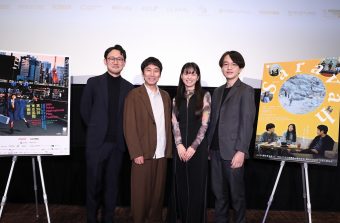
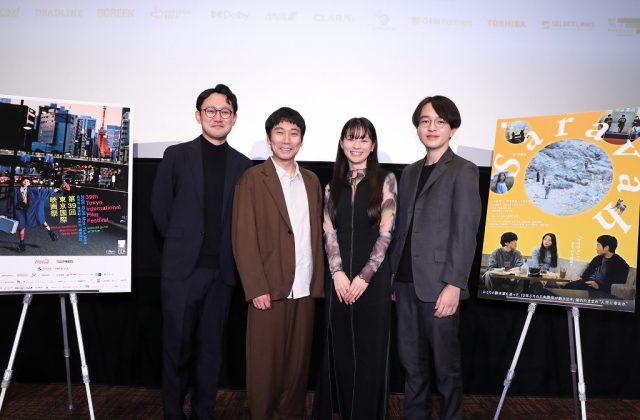
The Japanese film is the work of director Kujiraoka Hironori, who was in attendance at the premiere alongside the three lead actors. Otomo Ritsu plays Riku, an aspiring scriptwriter who is approached by the renowned screenwriter Ooto Kei, who is actually Hato (portrayed by Matsumoto Mai), to take over her pen name when the pressure of the job becomes too much. Together with Sakura, played by Tokunaga Osuke, Riku and Hato had been university friends who made a film called Gondola that won Hato a screenwriting prize before she disappeared under her alias and from contact with the group. The request brings them all together and face to face with the unresolved frustration and emotions of the love triangle that underpinned their work.
During the post-screening Q&A, Kujiraoka, who served as director, scriptwriter, cinematographer and editor, explained the film was inspired by the decade of stories he had witnessed or heard during his time as a filmmaker. “The genesis of this film is that I have been involved in drama or film production for 10 years now, and I am influenced by the people I have met. I obviously can’t disclose names to protect their identity, but for the people in this business, this work is not just a business. They believe in storytelling, and the people I admire are those that are very passionate. I am often inspired working under them and as a director. You begin to see things from different perspectives, and for this film I was definitely inspired by them.”
Regarding the title, which comes from a Portuguese word, Kujiraoka commented, “I had some ideas about ghostwriting and friends reuniting after 10 years. I was in search of a title when I found an album by musician Takahashi Yukihiro called ‘Saravah,’ and he explained that he’d encountered this word and its meaning, ‘may you be blessed,’ which I thought was fantastic. This is a story about coming to terms with your age and life continuing on, and it felt perfect for that.”
He said he wrote the script for the movie in April and shot the film on location in Gunma Prefecture during this past summer with a small team of just five crew and ten actors in various roles.
After a member of the audience praised the way the characters felt like flawed, very real people, the actors portraying these roles spoke about the inspirations that drove their performances in the film.
Said Otomo, “We had some script readings prior to shooting, but I wasn’t given much instruction from the director so I just got into the role naturally. Even though I wasn’t sure what to do when we started filming, I’m sure if it was wrong the director would have told me. He didn’t say anything so I went along with my instincts.”
Matsumoto added, “To be honest, there were so many elements about Hato that I couldn’t relate to. In some ways I could understand her, but just reading the script I couldn’t fully digest her character. When we had readings prior to the shoot, the director got the three of us together in a room, and when I saw Riku and Sakura and heard their words, I began to grasp the role and to build the character from there.”
With such a small and close-knit cast and crew, a lot of positive memories were made as the group filmed on location. In the film, Hato has given up screenwriting and is helping at her mother’s ryokan, where she now lives. The ryokan featured in Saravah is an actual inn where the cast and crew stayed during filming.
As the actors recalled, the food was especially delicious. “We all had breakfast together, and it was fantastic,” Otomo said. “One time (or more than once) I overslept and missed breakfast but the director woke me and told me I could still have breakfast, so I went to the dining area. When I got there, [another actor] was also there and we both had a late breakfast! But it was good bonding.”
As the Q&A session came to a close, director Kujiraoka stressed that the whole film had been very much a passion project that came together with a small team working hard to bring the film to life, and expressed hope that it will be released in Japanese cinemas next year. Through the lives and memories of its characters, the film showcases a love for screenwriting and for Gunma Prefecture, where the story is set and where the director reportedly shot another film shortly afterward.
Asian Future: Saravah
Q&A Guests: Kujiraoka Hironori (Director), Otomo Ritsu (Actor), Matsumoto Mai (Actor), Tokunaga Ōsuke (Actor)















Recent News