


“The Great Spirit World” Talk Show – Death Becomes Them: A Chat About Tamba Tetsuro’s Immortal Guide to the Afterlife
©2026 TIFF
World-famous auteur Miike Takashi turns out to be as adept at moderating talk sessions as he is at directing films that earn cult followings. And following the October 27 TIFF Japanese Classics screening of The Great Spirit World in a new 4K restoration, it was revealed that Miike also has a talent for spotting—and rescuing—cinematic oddities.
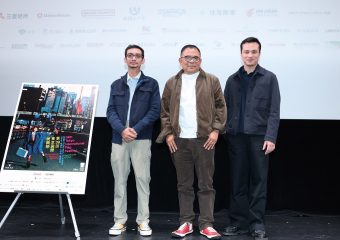
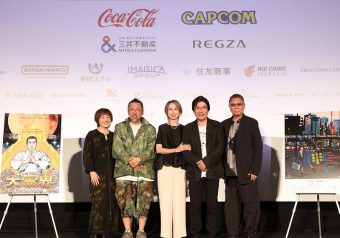
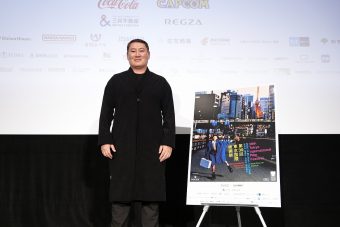
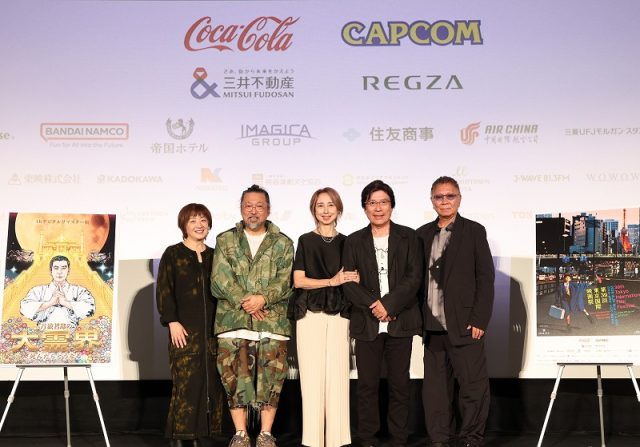
A huge fan of the film, first released in 1989, Miike was on hand, along with two of the film’s stars, its producer and renowned artist Murakami Takashi (who designed a new poster for the 4K restoration), to explain how the film came to be revived.
As the title clearly indicates, The Great Spirit World is about the afterlife, or, as the subtitle asks, “What happens when we die?” The answer to that question turns out to be quite detailed, presented as a kind of sci-fi fantasy complete with elaborate sets and special effects. The brainchild of the film was the late actor Tamba Tetsuro, who during his lifetime was quite obsessed with spiritual matters and the occult. The Great Spirit World is a distillation of his research into various faiths’ beliefs about what the afterlife entails and how you get there.
Though much of this research is presented in an edifying way, it’s all contained in a narrative about a bus disaster on a mountain road that kills a dozen passengers, whose progress into and through the spirit world is depicted. In Tamba’s scheme of things, life on earth is merely a “training ground” for our eternal life; while there is a heaven and a hell, one’s final destination is not determined by one’s morality or actions but rather by “where one naturally belongs.”
As it happens, the film itself was snatched from the jaws of death at the last minute.
“On the anniversary of Tamba-san’s passing (in 2006), there was a party, a kind of memorial,” Miike told the audience. “His former manager and others got together for drinks. I was there, too, drinking highballs at a pretty good pace, and Sakai-san from the Tamba Office said something like, ‘I’ve got the negatives of The Great Spirit World stored at a warehouse, and the fees are too high, so I’m thinking of throwing them away.’”
This news suitably shocked Miike, who told Sakai, “That movie is a masterpiece, a page in the history of the Showa Era!”
Miike sprang into action, consulting with an outside producer who agreed to oversee a revival.
As part of the revival, Murakami Takashi agreed to create a new poster for the film, as he was working with Miike at the time on another project. Consequently, the poster features dozens of Murakami’s trademark flower characters assembled at the feet of Tamba Tetsuro, since Tamba once said that the afterlife was full of flowers.
Joining Miike and Murakami onstage was Tamba’s son, the actor Tamba Yoshitaka, who played the lead in The Great Spirit World, as a physicist who is on his way to a scientific conference when his car runs off the mountain road, along with the bus. When Miike asked him how the movie came about, he said that his father had wanted to make a movie about the afterlife for quite some time, but no one was willing to get behind it. “Everyone just pretended to listen,” he said.
As it happens, Tamba wasn’t really interested in making a movie about the spirit world. Rather, he wanted to create a “guide” to the spirit world. “He made everyone forget their daily lives and focus on death itself,” the younger Tamba said about his father’s obsession. “I don’t know if that’s a way for humans to live happily.”
But he insisted that his father was not “a religious figure,” nor did he possess any “psychic abilities.”
“He was simply a researcher. He studied materials about the spirit world, and not just from Japan, but from all over the world.”
Saka Misako, the film’s producer, admitted she was very young when the film was made. She commented, “Tamba-san said that such a movie could not be made if an experienced producer got involved, and since he was friends with my father, he asked me if I’d be interested in producing simply because I had no industry experience.”
The film was written, produced and supervised by Tamba himself, and reportedly took some 15 years to bring to fruition.
Joining the others on stage was Okayasu Yumiko, who played Kiyo, an ancestor of the physicist character who guides him through the afterlife. “At the time, I had no interest in the spirit world at all,” she recalled. “In fact, I thought it was kind of scary. I thought this was a horror film. When I confessed that to Tamba-san on set, he just burst out laughing.”
Miike pointed out that Okayasu is not only an actor but also a racecar driver, which sounded a lot scarier than being in a horror movie. The audience laughed appreciatively.
Everyone who had known Tamba Tetsuro agreed he was a delightful person to be around. “He had a charming quality that women adored,” said Okayasu. “He was always chatting with the girls. That’s how it was.”
As a director, Miike noted that “from a compliance standpoint,” Tamba’s on-set behavior might have “caused an uproar” if it had occurred today; but he felt it demonstrated “that Showa-era generosity that produced such great actors like Tamba.”
Miike pointed out that Murakami himself was a film director who worked in independent cinema, just as Tamba did. Murakami responded by saying this independent spirit “has something to do with our generation. Younger people today might be more interested in video games, but when I was young, we were immersed in things like The Great Spirit World.”
Miike asked Tamba Yoshitaka to reflect on the experience of watching the film again after all these years, stressing that it was first released in the final year of Showa—or the first year of Heisei, depending on how one counts Imperial eras.
“I remember my father being a big, bold fellow,” said Tamba. “But he also had a sensitive side. I’m sure he’s so moved by this right now he’s crying somewhere.” He added that since the elder Tamba made a sequel to his opus, he hoped that Miike himself would direct a third installment. As it turns out, there is a third film being proposed, though on a smaller scale, called I Came Back to Life After I Died.
“I hope that everyone here watches this film once every ten years,” Miike told the crowd. “While you’re still alive, of course. I think you’ll view it in a completely different way each time.”
Japanese Classics: The Great Spirit World
Talk Show Guests: Miike Takashi (MC, Film Director), Saka Misako (Producer), Tanba Yoshitaka (Cast), Okayasu Yumiko (Cast), Murakami Takashi (Artist)










Recent News