


“Red Before Dawn” Q&A – The Bloody Path to Independence
©2026 TIFF
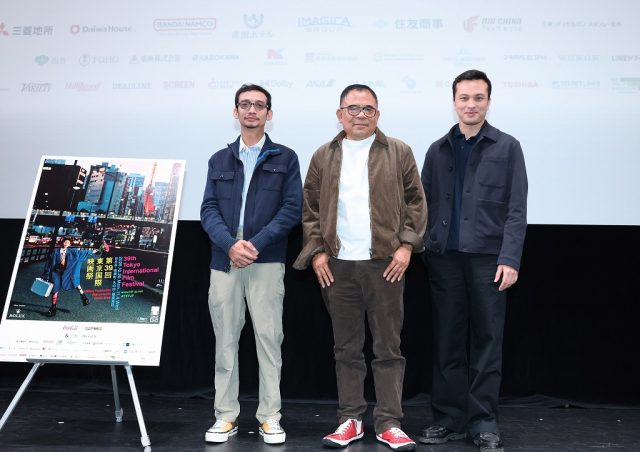
During the October 27 Q&A session after the world premiere of the Indonesian film Red Before Dawn, which screened in the Competition section of the 39th Tokyo International Film Festival, both the director, Garin Nugroho, and one of the two actors with him, Nagra Pakusadewo, choked up and had to compose themselves before continuing with their responses.
“I might shed tears again,” Nugroho warned the audience, “because during the time depicted in the film, there was much violence and inequality. This dark history of Indonesia is not written in books for children, and I believe it has to be opened to the public. We must reflect on it.” He again stopped, overcome with emotion, before saying loudly, “We must stop all wars, including Gaza, right now. We must stop them from robbing countries of their natural resources and killing people in the process.”
The history covered in the movie is the postwar struggle for Indonesian independence. It is a kind of complement to Mouly Surya’s This City Is a Battlefield (2025), which takes place during the same period but centers on the fight to oust the Dutch from Jakarta following the war. After the defeat of Japan, Indonesia’s previous colonizers returned with allied forces, including British soldiers, to take back what they thought was theirs. Having evicted the Japanese, the Indonesian people were set on freeing themselves from outside control. But the country was made up of dozens of regional ethnicities and languages, and these groups did not work toward forming a new country in a collaborative way. There was a great deal of internecine bloodshed even when they were fighting the Dutch.
The idea for the movie came from the producer and lead actor, Nicholas Saputra, who plays a mining engineer of mixed ethnicity—Dutch father, Indonesian mother—who is dedicated to the new cause. Most of the story concerns his journey from Jakarta to the provisional capital of the new nation, Yogyakarta, in order to help the fledgling government access the country’s abundant mineral resources. His companions are a motley bunch—a Rabindranath Tagore-quoting Indian Muslim driver, a Chinese nurse-in-training, and a blind radio operator who believes the people’s salvation lies in being able to communicate with one another across the entire country.
“The movie started three years ago when I was working on a movie musical about the history of Indonesian cinema, incorporating different political eras,” said Saputra, who had also joined the director for the Q&A session. “There was one era that was missing, however, and that was the postwar years of the struggle for independence, which is almost never addressed in Indonesian movies. Those that do focus on heroes in battle, but what about the civilian population? We had just declared our independence, but were we really free? So I proposed this idea to Garin.”
“When Nicholas told me his idea, I wanted to do it immediately,” recalled Nugroho. “People need to think about that time, because a lot of people died.”
Pakusadewo revealed that the shoot only took 15 days. “It was difficult,” he said. “I just want to acknowledge how hard everybody worked.”
Nugroho, ten of whose films have been shown at TIFF since 1991, is something of a polymath director, and one audience member was impressed by the breadth of styles embodied by his latest film, from Brechtian theatrical passages to scenes where the narrative is couched in traditional storytelling methods, as well as lively jazz numbers.
“My films always have singing and dancing,” said the director. “In Indonesia, when people are going through hard times, they always dance and sing. My films contain both tragedy and hope, and I always try to incorporate the customs of Indonesia in the way the film is presented. My art flows from cinema to plays, so I always think in those terms.”
Competition: Red Before Dawn
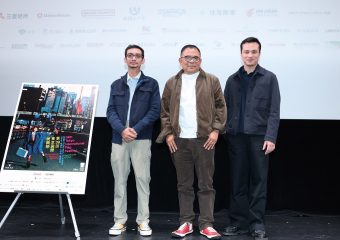
Q&A Guests: Garin Nugroho (Director/Screenplay), Nicholas Saputra (Actor/Producer), Nagra Pakusadewo (Actor)














Recent News