


Cascading Red Carpet Glistens Under a Steady Rain as TIFF Kicks Off Dynamic 39th Edition
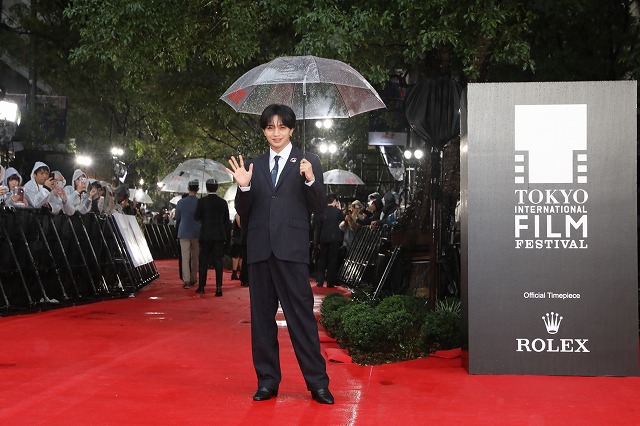
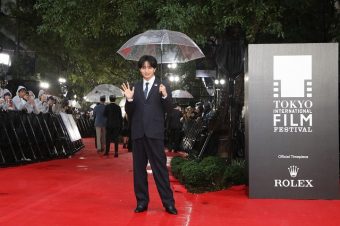
39th TIFF Festival Navigator Nakajima Kento ©2026 TIFF
The 39th Tokyo International Film Festival launched its 10-day run on October 26 with a procession of transparent umbrellas on the red carpet, as cinema luminaries from around the world protected themselves from a (mostly) light rain en route to the TIFF Opening Ceremony.
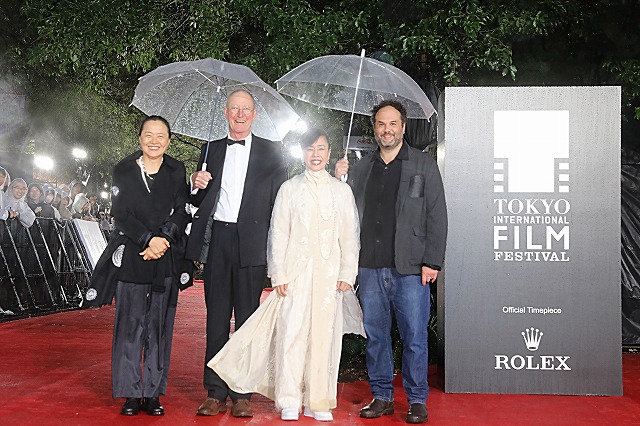
From left to right: Oh Jungwan, Rolf de Heer, Watanabe Makiko, and Yov Moor © 2026 TIFF
Nevertheless, spirits remained high as nearly 300 filmmakers, actors and leading lights from across all 11 sections of the festival, as well as the members of TIFF’s four competition juries, greeted an awaiting audience in ponchos before beginning their walk along the 250-meter carpet, where they stopped briefly for autograph and selfie seekers before ascending to Hulic Hall Tokyo, where the Opening Ceremony was to take place.
Among the international guests on the carpet were veteran Indonesian director Garin Nugroho and actor Nicholas Saputra, in town with their Competition title Red Before Dawn; Belgium-based director Teodora Ana Mihai and actor Violet Braeckman (Heysel 85); Macedonian American director Milcho Manchevski and actors Sara Klimoska and Filip Trajkovikj (Sister Brother Manhole Cover); Chinese director Qiu Jiongjiong and actors Wang Hi and Xue Xuchun (Fuxi: Four Tales of Feasting); actors Sunshine Teodoro and Nour Hooshmand of the Philippine film Filipiñana; Iranian Kurdish director Bahman Ghobadi with actors Murat Yildirim and Iman Yildirim (Trees Are Watching); Kazakh director Azamat Shargyn (Shyrmauyq); and Japan-based Taiwanese star Judy Ongg (Sunshine Women’s Choir).
Also gracing the red carpet were members of the esteemed International Competition jury, led by Jury President Rolf de Heer, an Australia-based writer, director and producer, alongside Korean producer Oh Jungwan, DI colorist Yov Moor, and Japanese actor Watanabe Makiko.
The red carpet also welcomed a delegation from the Academy of Motion Picture Arts and Sciences, the
organization behind the Oscars®. The delegation included CEO Bill Kramer, Chief Membership, Impact, and Industry Officer Meredith Shea, Amy Homma, Director and President of the Academy Museum of Motion Pictures and Academy Collection, Jennifer Davidson, Chief Marketing, Communications and Content Officer and Jenny Galante, Chief Revenue and Business Development Officer. Marking the Academy’s first participation in an international film festival, Kramer commented, “To be part of such a major platform as the Tokyo International Film Festival makes this especially meaningful, and we feel honored to be here.”
The many Japanese celebrities appearing included 39th TIFF Festival Navigator Nakajima Kento; Asano Tadanobu and Kishii Yukino, stars of the Cannes Un Certain Regard selection All the Lovers in the Night, with their director Sode Yukiko; actor Lily Franky (Diary of a Mad Old Man); actor Matsuoka Mayu and director Mishima Yukiko (Two Cigarettes, Three Nights); actors Deguchi Natsuki and Kitamura Takumi with director Nakagawa Ryutaro (Your Story – Kimi No Hanashi); actors Nagano Mei and Ito Kentaro with director Miyamoto Hidemitsu (The Night Queen of Himachi); actor Isomura Hayato, who’s serving as the Ethical Film Award jury president; director Sabu (Arrested Memory) with actors Kirishima Reika and Huang Guan-zhi; actor Ito Sairi and director Nagikawa Yoshiro (The Tiger and Her Wings – The Movie); cult director Ueda Shinichiro and actor Kato Shinsuke (Earthlings in Love); actors Miura Takahiro, Sugino Kiki and Mori Yusaku with director Enomoto Norio (What We Call Happiness); and director Tanaka Miki (silver express) with emerging star Okamoto Yui and cinematographer Tatsutomi Kohei.
The final red carpet appearance was made by actors Okada Junichi, Matsuzaka Tori and Seino Nana, stars of the TIFF Opening Film Sukiyaki, along with their director, Zeze Takahisa.
The Opening Ceremony moved inside the Hulic Hall Tokyo with the arrival and stage appearance of the guests from the red carpet, before Minister of Economy, Trade and Industry Akazawa Ryosei took the stage to welcome attendees, noting, “It’s my great pleasure to offer a few remarks on the occasion of the opening of the 39th Tokyo International Film Festival. I am truly delighted that we are once again able to welcome so many members of the film industry from Japan and around the world to Tokyo for this year’s festival.
“Japanese cinema continues to make remarkable strides. This year, Kingdom: Battle of Souls achieved the extraordinary feat of becoming the first film series in Japanese cinema history to have five consecutive installments surpass 5 billion yen at the box office, with cumulative earnings exceeding 30 billion yen. I find the continued success of Japanese cinema extremely encouraging. Against this backdrop, Godzilla Minus Zero, the centerpiece film that will bring added excitement to the middle of this year’s festival, is scheduled for release next month in Japan and numerous countries across Asia, North America, and other parts of the world. As you know, its predecessor, the 38th installment in the Godzilla series, won the Academy Award® for Best Visual Effects. I look forward to seeing this new film reach audiences around the world.
“I am also greatly encouraged by the way Japanese intellectual property—including characters such as Godzilla, as well as manga and anime—is reaching global audiences through film. These properties are also expanding into a wide range of businesses, including merchandising and events, creating new value and opening up new markets. Overseas sales in Japan’s content industry have grown to approximately 6.1 trillion yen, establishing the sector as one of Japan’s core industries.
“At the same time, major countries around the world are strengthening their industrial policies in the content sector, intensifying international competition for both public and private investment. In this environment, I believe it is essential for Japan to respond swiftly and flexibly with the necessary policy measures. The Japanese government aims to increase overseas sales in the content industry to 20 trillion yen by 2033. To support this goal, the government’s budget requests for fiscal year 2027 include approximately 250 billion yen across government agencies to support growth investment in the content industry. We will continue to make every effort to bring Japan’s compelling creative content to audiences around the world and further strengthen the industry’s international competitiveness.
“In closing, I sincerely hope that the Tokyo International Film Festival will provide opportunities for audiences to discover many outstanding films and serve as a catalyst for the emergence of new talent.”
Appearing via video, Prime Minister of Japan Takaichi Sanae told the audience, “I would like to extend my heartfelt congratulations on the opening of the 39th Tokyo International Film Festival. The Tokyo International Film Festival has continued to develop as Japan’s leading celebration of global cinema. By bringing together outstanding films and filmmakers from around the world, it has played a vital role in connecting Japan with the international community. I would like to express my profound respect and appreciation to all those whose dedicated efforts have made this festival possible over the years.
“Film has the power to connect people across national and regional boundaries, and to deepen mutual understanding of diverse cultures and values. It is particularly meaningful that filmmakers and audiences from countries and regions around the world come together in Tokyo, creating opportunities for new encounters and dialogues. I sincerely hope that this festival will inspire extensive exchange and foster new forms of collaboration and co-creation.
“The Takaichi Cabinet has designated the content industry, including film, as one of the 17 strategic sectors under Japan’s Growth Strategy. In line with the public-private investment roadmap, we will accelerate domestic investment through close public-private cooperation. Toward achieving the goal of expanding overseas sales of Japanese content to 20 trillion yen by 2033, we will provide large-scale, long-term strategic support. This will include supporting the production of Japanese films that captivate audiences around the world and promoting Japan as a destination for international film and TV productions.
“I sincerely wish everyone gathered here continued fulfillment in your endeavors, and the 39th Tokyo International Film Festival every success. I look forward to the further development of film culture in Japan and throughout the world.”
Following an overview of the festival’s main competitive sections, awards and film highlights, 39th TIFF Festival Navigator and actor Nakajima Kento appeared. He commented, “TIFF’s red carpet is a special place. I walked it today, which was such an honor. It was raining, but it felt like a life-giving rain. When we think about the festival’s role, all the greatest creative minds from around the world have gathered here, and this can be a life-changing experience for filmmakers as well as for film viewers. I had the opportunity to walk a red carpet at the Academy Awards several years ago, and I saw how they helped bring Asian films to the world. I hope we’ll witness that at this festival, too. I’m honored to participate as the Festival Navigator. I feel like we’re on a cinema journey, and I hope that your journey will be rich and wonderful. I look forward to embarking on this journey with all of you.”
Members of the Nippon Connection Now jury then greeted the audience from their seats: film critic Mathieu Macheret, producer Murata Chieko and Sabrina Baracetti, president of the Far East Film Festival; as did members of the Asian Future jury: producer Eiko Mizuno-Gray, director Fujimoto Akio and producer Yulia Evina Bhara. The International Competition jury were then called on stage.
Speaking on behalf of his fellow jurors, Jury President Rolf de Heer told the audience, “Arigato. Whether it is as an actor or a colorist or a producer or a director, we on this jury are all filmmakers. As filmmakers, we have each of us directly or indirectly been influenced by the great Japanese masters. I remember seeing an Ozu film 50 years ago, and one shot that was so perfect. Oshima, Kurosawa — Dersu Uzala remains in my brain. We as the jury are very privileged to be able to work in the country of those masters. As filmmakers, we have a passion for cinema. And with that passion, with integrity, we will work to reach the best possible result in the competition. We are privileged for the opportunity. Thank you.”
The audience was then treated to a trailer of Sukiyaki, TIFF’s Opening Film, before three of the film’s stars—Okada Junichi, Matsuzaka Tori and Seino Nana, along with director Zeze Takahisa—took to the stage.
Sukiyaki tells the untold story behind the historic song that topped the Billboard charts and remains one of the world’s best-selling tunes: the 1963 “Ue o Muite Aruko,” which was retitled “Sukiyaki” for international audiences. It became the first Japanese-language song to top the US Billboard Hot 100, holding the No. 1 position for three consecutive weeks.
Zeze’s lavish musical drama stars Okada as composer Nakamura Hachidai, Matsuzaka as lyricist Ei Rokusuke and Nakano Taiga as singer Sakamoto Kyu, who despite many differences, come together to create the song and perform as the popular 689 trio. The film traces their creative collaboration, shared ambitions and personal struggles, as well as the many setbacks, differences and disappointments they encountered along the way.
Okada looked very pleased as he thanked the festival for selecting the film as the opener. “We are greatly honored, and I hope you’ll be able to experience the strength of Japanese film and music as you’re watching.” Matsuzaka concurred: “It’s a participatory film. Allow yourself to be immersed in it, and you’ll feel as if you’re at a live concert.” Seino, who plays the wife of the composer, told the audience: “This is such a special experience. I was in the audience myself, during some of the shoot, watching my fellow actors perform, and it was tremendous. I hope you’ll enjoy it to the very fullest.”
Director Zeze added: “Right after the war, the Japanese economy grew significantly. The characters in this film are thinking about what they can do to achieve peace. I hope you will enjoy the film, and through this film, I hope the Tokyo International Film Festival will also be a celebration of peace.”
As the ceremony came to an end, TIFF Festival Director Hisamatsu Takeo gave thanks to supporters and spoke of his own passion for cinema: “Ladies and gentlemen, thank you all very much for joining us today, despite your busy schedules and the inclement weather,” he said. “And to our many international guests who have traveled from overseas, a very warm welcome to Tokyo!
“We are able to celebrate the opening of the Tokyo International Film Festival thanks to the generous support of so many individuals and organizations. I would like to express my sincere gratitude to the Ministry of Economy, Trade and Industry; the Agency for Cultural Affairs; the Tokyo Metropolitan Government; and all the other government agencies and organizations that have given us their invaluable support. I would also like to extend my heartfelt thanks to Rolex, our Official Timepiece and a sponsor of this Opening Ceremony, as well as to all our other corporate sponsors. And, of course, my deepest appreciation goes to the many organizations and professionals throughout the film industry who work tirelessly to advance cinema, both as an art form and as an industry. To all of you, thank you. We are truly grateful.
“I have actually been part of the industry myself for nearly 50 years. In that time, I have encountered an incredible variety of films and had the privilege of being involved with many of them, from live-action features, animation, documentaries, to short films and many more. I’ve been involved with films from Japan, the United States, across Asia and Europe, the Middle East, Latin America, Africa, and beyond. And when it comes to genres—drama, comedy, science fiction, romance, action, adventure, musicals, thrillers, mysteries, horror, period dramas—the list is endless.
“I never tire of cinema, and I would like to share that enjoyment with you. And so, with that spirit of excitement and anticipation, it is my great pleasure to declare the 39th Tokyo International Film Festival officially open!”
TIFF’s 39th edition, running from October 26 – November 4 at venues in the Hibiya-Yurakucho-Marunouchi-Ginza area of Tokyo, will feature 204 films, Q&A sessions, symposia, masterclasses, TIFF Lounge talk sessions and an enormous array of allied events. The Kurosawa Akira Award will be bestowed to two previously announced recipients, as will a range of awards to the chosen films. Fifteen titles are competing for the Tokyo Grand Prix in the festival’s International Competition, drawn from 1,892 submissions from 112 countries and regions.
Outline of the Opening Event and Festival Numbers
Date: October 26 (Mon)
Red Carpet started at 3:00 pm at Tokyo Midtown Hibiya, Hibiya Step Square
Ceremony started at 5:30 pm at Hulic Hall Tokyo
Total number of guests on the Red Carpet: 262
Number of press members covering Red Carpet and Opening Ceremony: 214
Length of the Red Carpet: 250 meters
Number of audience at the Red Carpet: 620
Number of films at the 39th TIFF: 204











Recent News