


“Two Cigarettes, Three Nights” Q&A – Forging an Unconventional Bond
©2026 TIFF
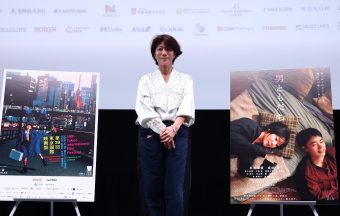
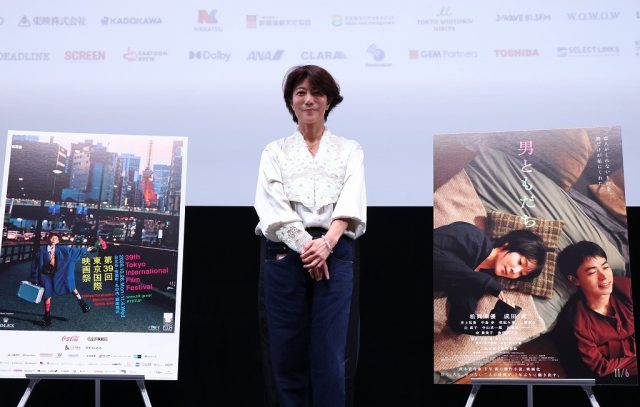
Japanese director Mishima Yukiko has a long history with the Tokyo International Film Festival, not only screening previous works but also conducting a masterclass and appearing in conversation at the TIFF Lounge. But the intimate drama Two Cigarettes, Three Nights marks her first film in the main Competition, and the director happily fielded questions from a very enthusiastic audience following its world premiere at the 39th TIFF on October 27.
Before taking questions, the director explained, “I tried something new with this film—I tried not to just tell a story, but to make you actually feel the film physically through image and sound.” She then introduced key members of her team who were sitting in the auditorium: cinematographer Otsuka Ryo, the art director and sound director, all of whom contributed greatly to fulfilling her aims.
Mishima’s beautifully lensed eleventh feature explores the elusive boundary between friendship and love through powerful long takes and nuanced performances, capturing the awakenings of a young woman who has been drifting through her adult life. The film follows Kanna (Matsuoka Mayu of Palme d’Or winner Shoplifters), a talented but emotionally stunted illustrator in Kyoto who, approaching 30, finds herself struggling creatively. She is also beginning to confront just how unfulfilling her relationships have been, and the effort is stunting her busy career. An unexpected phone call reunites her with Haseo (Narita Ryo of Talking the Pictures), a longtime male friend who has always understood her in ways others cannot. Meeting again after seven years, the two spend three nights together in Kyoto, Toyama (where he lives) and Hiroshima, rekindling a connection that defies conventional definitions of romance or friendship. By film’s end, it will have shifted the course of her life and career.
TIFF Programming Director Ichiyama Shozo asked Mishima about the process of discovering and adapting Chihaya Akane’s bestselling 2014 novel “Otoko Tomodachi” (“Guy Friend”), and she responded, “I first read the book in 2020, during Covid. All the cinemas were closed and the film I was scheduled to shoot was canceled. Then I suddenly got a call from a stranger, from a producer, Sugimoto Yusuke. I didn’t know him, but he asked me if I’d like to make a film of the book. I felt this phone call was kismet, like God’s hand.”
She explained, “I think the novel is about how people can be with others. It depicts the relationships between the protagonist and her male friends, but she’s also an artist who’s lost her way and is just drifting through life. When I was thinking about this, I thought maybe we could convey a message to the world through the painting that we see at the end of the film.”
She elaborated after an audience member, who told her he was “still shaking, it was so wonderful,” suggested that the painting “depicts the moment when Kanna found herself.”
Nodded Mishima, “That conveys the same message as the film, without words. What’s very important is that Haseo is always watching Kanna, he is seeing her. While making the film, I began wondering whether I was really seeing the world myself, whether I was looking at what’s happening around me. When we went to Hiroshima, we discovered that the people there do not look away when they pass the Hiroshima Peace Memorial. They stop, face it and offer prayers. This is what Kanna does with the painting. That was created for us by the artist Tanaka Chisato. She starts always with a black canvas, and that’s a style I wanted Kanna to adopt.”
Asked about the sound, which is meticulously designed, Mishima said, “I think this is something we should be proud of in Japanese cinema. We pay attention to sound. The sound of insects is an actual voice, not just noise, for example. We pay attention to everything, even the sound of lips opening and closing. So this film must be seen in the cinema on a big screen, so you can hear all these subtle sounds.”
She also mentioned, “The distance between Kanna and Haseo is very important, so we used CinemaScope to capture that. In the beginning, the characters are always looking in the same direction, but at a certain point, they begin to face each other. We gave the cinematography a lot of thought.”
Asked about her casting of Matsuoka and how she got her to make such “marvelous expressions,” Mishima told the audience, “I’ve been following Matsuoka Mayu’s work ever since I saw her in The Kirishima Thing (2012). What struck me was how thoroughly she seemed to develop her characters, right down to the way they walk and stand. You can see exactly what I mean if you watch that film. I was really impressed by how carefully she constructed her performance, starting with fundamental physical details. I’ve been paying close attention to her work ever since.
“Kanna is someone who harbors desires that are difficult for others to understand. And I had the impression that Matsuoka-san herself might also carry something inside her that remains unfulfilled. I wondered whether she, too, might have this insatiable, almost parched desire to express herself—to do more. That was what made me think that I really wanted her to play Kanna.”
Mishima also spoke about her approach to directing actors. “I generally try not to tell them exactly what to do or how to do it,” she said. “The first thing I do is establish the physical space. I choose the location and create a space where I can imagine how people would naturally move, and how these two particular characters would interact with their surroundings. In other words, I set the stage first.
“The art department plays an important role in this. They carefully consider where and how to arrange the props and set decorations so that the environment naturally encourages certain actions from the actors. Everything is placed with an awareness of how it might guide the performances.
“But perhaps the most important factor—and I think this is the answer most relevant to your question—is the performance of the actor playing opposite Matsuoka: Narita Ryo, who plays Haseo. Rather than giving Matsuoka instructions directly, I would whisper something to Narita-san. He would then adjust his performance in a way that guided her response and brought out those ‘marvelous expressions.’ I believe that’s the result of two talents working together: Matsuoka-san’s own abilities and those of her fellow actor, Narita Ryo.”
Competition: Two Cigarettes, Three Nights
Q&A Guest: Mishima Yukiko (Director)













Recent News