


“Trees Are Watching” Q&A – … And Chairs Are Moving
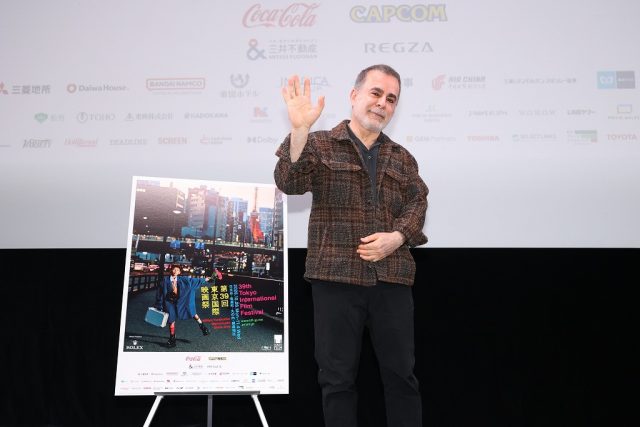
©2026 TIFF
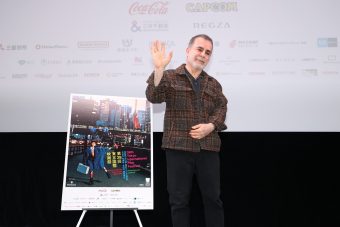
The Kurdish-Iranian director Bahman Ghobadi presented his latest feature, Trees Are Watching, in the Competition section of the 39th Tokyo International Film Festival on October 28, marking its Asian premiere.
Since debuting internationally in 2000 with his acclaimed first feature, A Time for Drunken Horses, Ghobadi has enjoyed steady reputational growth as a world-class filmmaker, broadening his scope from regional stories like the harrowing Turtles Can Fly (2004), which focused on children in a refugee camp on the Iraq-Iran border awaiting liberation by the U.S., to international-scale films like Rhino Season (2012), based on the life of Kurdish poet Sedigh Kamangar, who was imprisoned for 27 years by the Iranian authorities, which starred Monica Bellucci and was presented by Martin Scorsese.
Trees Are Watching, which stars Eva Green and is executive produced by Scorsese, demonstrates further global ambition. More importantly, it marks the arthouse auteur’s first venture into genre filmmaking, and he fashions a horror film that slowly shifts from the occult to the psychological.
Green plays a London-based writer named Darya who returns to her hometown in Turkey to research the city of Mardin, whose citizens were once forced to move underground due to climate circumstances not unlike those that presently plague our planet. Darya fashions her thesis around a Kurdish belief that people are reborn as trees, which suffer for man’s careless treatment of the earth (a situation fortified by Ghobadi’s many overhead shots of the area’s deforestation).
Darya, we soon surmise, is suffering from a childhood trauma that she hopes to exorcise by revisiting her birthplace, where her relationship with a pair of sisters living nearby has led to her trauma. Throughout her ordeal in Mardin, Darya is haunted by the spirits in the trees surrounding her rented house, as well as a particularly diabolical chair that she believes contains the spirit of the abusive mother.
During the post-screening Q&A, one audience member asked about this belief, wondering about its provenance. Ghobadi answered that the idea of trees having souls was essentially his, but that the Kurds “live in the mountains, close to nature, so trees are very close to them, both physically and spiritually.”
Apparently, the idea for the story had been gestating a long time. “I had been thinking about it for more than 20 years,” Ghobadi told the audience, “and about 15 years ago I was living in a cottage in Iran that was surrounded by trees, and I had a great vision of my relationship with nature, which has always evoked a feeling of loneliness.”
Ghobadi, whose status in Iran was compromised by his films and his Kurdish background, has lived in exile for many years and is now based in Turkey. Expanding on the theme of loneliness in the film, he added, “I’ve been away from my country for a long time, and I feared my government’s retribution so much that I slept with a knife by my pillow. From there I wrote poems about death and became interested in horror stories.”
Trees Are Watching turns quite dark, with Darya and her deaf daughter Connie persecuted by, of all things, the wooden furniture in her house, including the aforementioned possessed chair. It’s probably the only film in the annals of cinema whose centerpiece is a fight to the death between a human being and an upholstered dining room furnishing. It also contains the cruelest plumber you could ever imagine.
This detour into more conventional entertainment seems to have given the director a new sense of purpose. “I am much happier than I was previously,” he admitted. Citing charcoal, a by-product of one of the film’s most potent images, of burning wood, he said that he was “burning with new energy” making films “outside my homeland.”
One viewer was curious why he made the daughter deaf, and Ghobadi replied that it was for narrative purposes. “At first, the movie was about a family—a father, a mother, and a child—but then I got rid of the father and just had the mother and the daughter. I didn’t want the daughter to talk too much, because it is the silence that makes the film more intense, so I took away the child’s power to speak.” As it turns out, the first girl selected to play Connie died tragically just before shooting started, so the film is dedicated to her.
It was perhaps inevitable that Scorsese’s name would come up, given that his name appears at the start of the credits. As it turns out, the American director had nothing to do with the film’s financing, which was done locally in Turkey.
“I’ve known Mr. Scorsese for a long time,” said Ghobadi, “as a friend and also a kind of uncle. After I left Iran and was living in Iraq, he used to call me to ask how I was. I asked him to watch [Trees Are Watching] and give me his opinion, and the only thing he said afterwards was ‘Why are the chairs moving?’ I asked him to watch it again, and he did, and then he said he got it.”
Competition: Trees Are Watching
Q&A Guest: Bahman Ghobadi (Director/Screenplay/Producer)















Recent News