


“The Canary’s Lullaby” Q&A – Like a Combination of Ozu and Studio Ghibli
©2026 TIFF
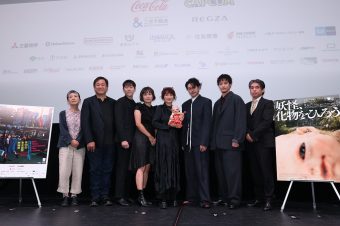
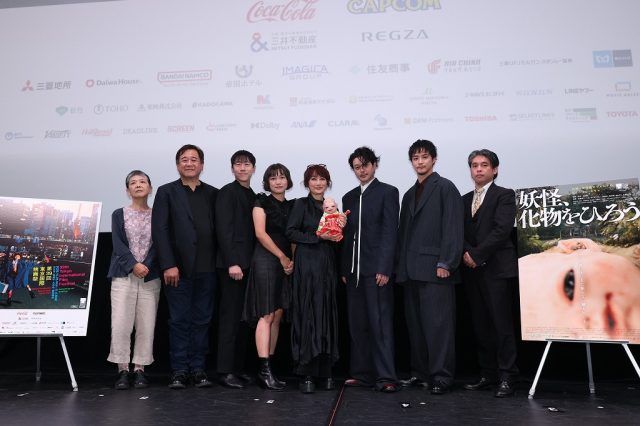
Photo from left: Osaka Fumiko (Producer), Arthur Chu (Producer), Wen Yu-Min (Actor), Chen Shu Ting (Actor), Yo Kimiko (Actor), Odagiri Joe (Actor), Shiraishi Shunya (Actor) and Ikeda Akira (Director)
Photo from left: Osaka Fumiko (Producer), Arthur Chu (Producer), Wen Yu-Min (Actor), Chen Shu Ting (Actor), Yo Kimiko (Actor), Odagiri Joe (Actor), Shiraishi Shunya (Actor) and Ikeda Akira (Director)
Japanese indie director Ikeda Akira is a master at creating otherworldly realms, but not the kind you find in anime or video games. He unveiled his latest creation, The Canary’s Lullaby, in the Competition section of the 39th Tokyo International Film Festival on October 28, then joined actors Odagiri Joe and Yo Kimiko—who was cradling the little baby Haru, dressed up in her eldest son’s kimono for the occasion—to field questions from the audience following the world premiere screening.
The trio (oops, make that quartet) had earlier greeted the audience, along with several other actors and producers from the Taiwan-Japan coproduction and thanked them for choosing to watch this “rather strange film.” Indeed, Ikeda is known for his offbeat humor and unconventional storytelling, both of which are in full force in The Canary’s Lullaby and enhanced by the spectacular strangeness of the setting: an indeterminate era in a village on an island that’s been devastated by a storm. As it turns out, it was filmed on Taiwan’s Kinmen Island, allowing the director to draw on local architecture, ancestral beliefs and traditional Wind Lion God culture.
Inspired by a mysterious incident that occurred in 1996 in Russia, the story follows Tae (Yo), an elderly woman who makes a modest living selling grilled rice dumplings (wanzi). One day after a big storm, she discovers an oddly deformed, humanlike baby in a wooded area. Despite the townspeople’s fear and suspicion, she names the child Haru and devotes herself to raising it. But not everyone loves the tyke as Tae does—even when he farts, which he does prodigiously. As hysteria rises, Haru is hunted as if he were a monster. (The parallels to the Frankenstein story aren’t as obvious as they sound.) At first able to protect Haru, Tae is eventually forcibly hospitalized, and the child seems to disappear. And then, one day, a new storm arises.
Curious to hear more about the Russian incident, the moderator asked the director to elaborate. “[It’s] an almost unbelievable true story,” said Ikeda, “quite similar to what you see in the film. An elderly woman found a strange child—or rather, something that wasn’t quite human—and took it in and raised it. There are apparently photographs and some video footage connected to the incident. When I first heard the story, I was fascinated by the idea that a human being could raise another creature with genuine love and affection, even though they weren’t related by blood or even members of the same species. It made me think about the extraordinary capacity human beings have for love, and just how far that love can extend.”
The film was produced by busy actor Odagiri, who also plays a small role. Asked which came first, he responded, “I was originally approached as an actor. But I actually knew about that Russian story myself and had been interested in it for quite some time. So when I heard that someone was planning to make a film based on it, I thought it sounded like a fascinating subject. I’d also known producer Osaka Fumiko for about 20 years. We’ve worked together many times, and she’s helped me a great deal over the years. So when she approached me about the project, I was immediately interested.”
“Then I went back and watched Mr. Ikeda’s previous films (which include award-winners Anatomy of a Paper Clip (2013) and Ambiguous Places (2017), which screened in the Japanese Cinema Splash section of TIFF, and The Blue Danube (2021)). They were incredibly interesting. I really hope all of you will seek them out. It’s remarkable that a filmmaker like him is still making this kind of work in Japanese cinema in the 2020s. His films offer a cinematic experience that almost feels like a combination of Ozu and Studio Ghibli. There’s something wonderfully comfortable and pleasurable about the spaces he creates and the experience of watching his films.”
He went on to stress, “It’s extremely difficult to make films like that today, especially because it’s so hard to raise financing for them. Although I’m credited as a producer, I haven’t actually done much of what people normally associate with producing. I haven’t been out raising money or anything like that. My feeling was simply that if there was anything I could do to help bring such a rare talent to a wider audience, I’d be happy to do it.”
Veteran actor Yo was asked what it had been like working with Haru. Joking that she was “almost jealous” of the attention received by her young costar, Yo recalled, “Whenever Haru was brought onto the set, everyone handled him with such extraordinary care. People even wore gloves when carrying him around, as though he were some enormously important star! And if you look at the poster, Haru gets this huge close-up, while I hardly get any close-ups at all in the film!
“But filming on Kinmen Island was an extraordinary experience. Haru wasn’t created with CGI. He was physically there, right in front of me. And the beautiful scenery of Kinmen Island was real, too. Simply being in that environment and speaking the lines director Ikeda had written was enough to transport me into his world. It felt like entering a wonderland, a strange and mysterious place. The entire shoot had this dreamlike quality. It was a truly magical experience.”
Prompted about her first impression of her costar, Yo admitted, “When I first encountered Haru, I remember thinking, ‘What on earth is this thing?’ But gradually, I began to find him adorable. The crew started talking to him as though he were a living creature. It was fascinating to watch Haru gradually become a character in his own right. He laughs, cries, and makes all sorts of expressions, and those movements were created by about five puppeteers working underneath him. They were putting real feeling into every movement. That’s something that requires an actor’s sensitivity.”
Apparently, there were several Haru puppets. The director explained, “We had about six different heads for Haru, and five or six bodies. We also had separate versions for the cocoon and molting sequences. There were actually so many different versions that I can’t remember the exact number. But the Haru you see here onstage was our main puppet, the one we used for most of the moving scenes. I’d say this particular Haru appears in about 80 percent of the film.”
An audience member wanted to know what Yo and Odagiri were eating during a rather tense scene at a dining table one dark night, and this occasioned a long discussion about noodles and oysters—which are apparently a specialty of Kinmen Island—before Yo said, “Every day when we had lunch, there would be all sorts of mysterious things in our boxed lunches. I actually looked forward to finding out what we’d be eating each day. Sometimes there would be chicken heads or feet, or people would bring us Peking duck.”
Asked why he chose to shoot in Taiwan, considering the complicated history between Japan and Taiwan, and the complex situation on Kinmen today—as well as his decision to mix Japanese with local languages and to include historical costumes—Ikeda responded, “When I first began developing this film, one of my main ideas was to create a fictional place in a fictional time. Initially, I didn’t think we’d be able to shoot in Taiwan, so I started looking for somewhere in Japan that could convey the feeling of an imaginary place.
“Then our producer, Osaka Fumiko, suggested Kinmen Island. When I first saw photographs of the island, I was struck by its distinctive landscape. It didn’t look like Japan, but it didn’t resemble Taipei or other familiar parts of Taiwan, either. It had an atmosphere entirely its own. I immediately felt that this was a place where we could create the sense of a fictional world, somewhere that didn’t belong to any specific country or historical period.
“The same idea informed our approach to language. I didn’t want the film to feel specifically Japanese or Taiwanese. I wanted to preserve that sense of an imaginary place. So we ended up using roughly four different languages in the film. That mixture was a deliberate choice to reinforce the fictional setting. [Also], every building and interior you see in the film is an actual location on Kinmen Island. We didn’t construct any sets. If you visit Kinmen Island, you’ll probably recognize many of the places you saw in the film.”
Finally, Odagiri was asked, “Having worked with director Ikeda as an actor, did you discover anything about his filmmaking approach that helped you understand what makes his work so distinctive?”
Admitting that he probably couldn’t put it into words, Odagiri said, “When you look at older Japanese films, particularly those by Ozu, there’s a preference for very restrained performances. I sense something similar in director Ikeda’s work. It reminds me of my experience working with director Oguri Kohei some years ago. He told me he didn’t want actors to explain things through their performances. He didn’t want us to communicate every emotion through our facial expressions or the tone of our voices. He said that an actor’s job isn’t necessarily to hand the audience an answer. Instead, you should leave room for the audience to imagine different possibilities. Even an expressionless face can suggest many things. A line delivered without any obvious emotion can allow viewers to interpret it in their own way.
“That idea was incredibly stimulating for me as an actor, and I learned a great deal from it. Because explanatory acting is actually quite easy. From a technical standpoint, it’s relatively simple to show an audience exactly what a character is feeling. What’s much more difficult is stripping all of that away. That’s extremely challenging. And I had the impression that director Ikeda was the kind of filmmaker who would ask that of his actors.
“I think the same is true of Ms. Yo’s performance. If she had played this character in a film by a different Japanese director, perhaps the old woman would have been portrayed in a much more expressive or explanatory way. But I think Ms. Yo found exactly the right balance for this film. She seemed to be constantly holding something back, resisting the temptation to express too much. And to me, that’s one of the greatest attractions of director Ikeda’s work.”
Competition: The Canary’s Lullaby
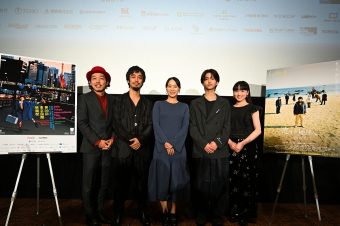
Q&A Guests: Ikeda Akira (Director), Yo Kimiko (Actor), Odagiri Joe (Actor), Shiraishi Shunya (Actor), Chen Shu Ting (Actor), Wen Yu-Min (Actor), Arthur Chu (Producer), Osaka Fumiko (Producer)














Recent News