


“Magic Atlas” Q&A – Transcending Artistic Boundaries
©2026 TIFF
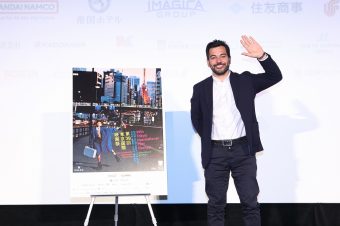
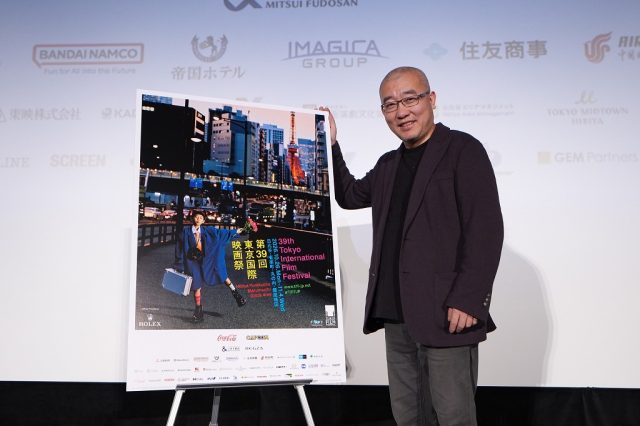
Ten years. Ten years was how long it took for Magic Atlas to evolve from an idea in the mind of Chinese director Sun Xun into the first animated feature selected for the Competition section at the Tokyo International Film Festival. Marking the occasion, Sun himself was in attendance at the 39th TIFF on October 29 to greet the audience and discuss what it took to bring together human history and art in all its forms to create such a compelling, philosophical work.
Magic Atlas is set against the backdrop of a fictional empire, as a magician acts alone to use his power to help its subservient people recall the memories and ideas they lost under authoritarian rule. After eventually being arrested for his insubordination, he meets an orphan boy in prison and hands him a book that reveals to the child the memories of life hidden by the ruling powers. The journey the boy takes with this book interweaves real-world history with artistic styles from around the world, with the book serving as a conduit for exploring how human creativity allows the memories of the world to live forever.
The film often blurs the line between cinematic storytelling and a work of contemporary art, a deliberate directorial choice by Sun. “For the last ten years, I researched and I explored many places to find inspiration for this film,” he told the audience. “I visited the stone cave paintings in Dunhuang, I studied the history of painting in the Song dynasty, I studied calligraphy history. All of it was crucial for the film’s development. [I did] a lot of research into traditional arts, such as calligraphy, and I learned that over the past 2,000 years of Chinese history there were many forms and styles of calligraphy with various masters. So I practiced all of them. I did all of this to elevate the animation of the film as an art form.
“Since the age of 16 I have been practicing art, and I’ve been working as an artist for so many years, so I wanted to create this piece of art as a way to make a statement and voice my opinions through my work. I wanted to make an appeal to art history. I call this film ‘animation,’ but it’s not exactly that.
“Through this work, I want to make a contribution to art itself, and to culture. The Tokyo International Film Festival selected this movie as part of the Competition, which shows the festival doesn’t consider my work merely as animation but something more, and I am very grateful for that.”
Sun explained that the film’s animation was created through an extraordinarily labor-intensive process rooted in traditional artistic techniques, with the resulting images individually scanned into a computer for further processing.
“So, how do we animate it? I had to start from scratch. I would think deeply about the movement from the start, and then I would make it. Why would it take 10 years? I’d use ink. For many scenes, I would use woodblock prints, so I would have to cut into it for every frame. Wood is also not flat, so I would have to use hot wax and apply it to the piece to make an even surface, and only then could I do the printing of the frame using the block print. You can only imagine how long that takes.”
By leaning into hand-sculpted, traditionally crafted processes, often at much personal sacrifice both in time and cost, Magic Atlas was brought into the world.
Bringing the talk to a close, Sun laid bare just how much sacrifice was needed to complete the film: it required him to create and sell his own paintings and other artworks, including pieces used in the film. Most of the drawings featured in one scene would then be sold to finance production of the next scene.
The results speak for themselves. At times, watching Magic Atlas feels less like watching a film and more like witnessing the unfurling of a scroll documenting human creativity and virtuosity itself, wrapped in the framing of a work about why that creativity is essential. That is an emotion emphasized in every hand-drawn and hand-carved frame.
Competition: Magic Atlas
Q&A Guest: Sun Xun (Director/Producer/Screenplay/Editor)












Recent News