


Angela Schanelec and the Consequences of Everyday Life — An Exclusive Interview
©2026 TIFF
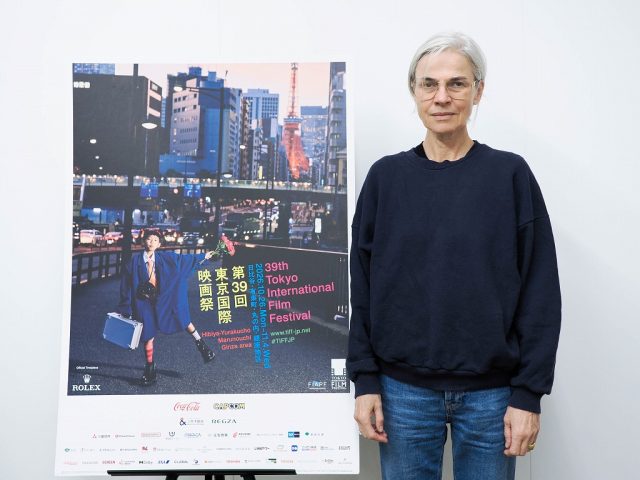
The German director Angela Schanelec has made approximately a dozen feature films since she started making films in the 90s, though none have been released theatrically in Japan. Nevertheless, she has visited Japan for retrospectives and special screenings. Her latest film, My Wife Cries, is in the World Focus section of the 39th Tokyo International Film Festival, which she is attending. Following her participation at the festival, she will appear at another retrospective in Tokyo as well as several universities.
During an interview conducted at the festival, she pondered the marketability of her work. My Wife Cries had its premiere at the Berlin International Film Festival and opened in Germany in June. So far, the only other markets where the film has secured distribution are the U.S. and South Korea.
“I think my films are quite difficult to sell,” she says.
Perhaps the most common adjective used to describe Schanelec’s work is “elliptical.” In conventional dramatic films, scenes are built around important plot points, but Schanelec’s movies usually elide these kinds of scenes, concentrating instead on the everyday lives of the characters and how those lives have been affected by the dramatic incidents we don’t see.
The central incident in My Wife Cries is an automobile accident involving the main female character and her lover. We are only made aware of this accident because the woman describes it to her husband during a remarkable unbroken monologue, confessing her infidelity as they walk along a city sidewalk. The scene ends with the husband collapsing from despair.
“Everything that happens in the film is a consequence of something that happened before,” said Schanelec, who admits that her structures don’t always satisfy conventional filmgoing expectations. “When I write a situation I’m not thinking that the situation has to end in order to get to the next plot point,” she says. “The scene is only as long as required for that situation. In that particular scene, the wife needs a long time to explain what happened to her, so it cannot be shorter. That means it’s set to a different rhythm than one the viewer might be used to.”
©2026 TIFF
In that regard, Schanelec’s stories are affected more by time than by circumstance. “The story happens by itself,” she says. “There is only a story because time moves forward, and things happen one after another,” but that doesn’t mean you have to show every moment contained in the story.
In her 2019 film, I Was at Home, But…, which received the Silver Bear for Best Director at the Berlin International Film Festival, a teenage boy goes missing for a week, but we never see what the boy did during that week or even what led to his disappearance. We only see how the disappearance affects his mother after he returns as she goes about her business. These quotidian aspects are important to Schanelec.
“Everyday experiences are our lives,” she says. “I don’t think our lives are separated into interesting things that other people don’t experience and less interesting things that we think are so small no one will care. Life’s not like that. The time the mother spends buying a bicycle, or sitting with her daughter in front of the computer, and on and on—that’s her life. And it’s our life. When something different happens we may not be able to explain why, but we can at least describe it.” And that, essentially, is how she tells stories.
She elaborates: “People generally go to movies to forget themselves, to become emotionally involved. Movies that bring out these emotions are based on specific stories and circumstances that may or may not be related to reality. A viewer wants to understand easily and so they go see these conventional films. I’m not interested in that kind of understanding. I think it’s a lie. It’s fake.”[mw1.1]
In order to tell these kinds of stories in a way she thinks is more honest, she controls the filmmaking process with great care, which leads to an austere style based on static scenes and absolutely no improvisation.
“The dialogue is completely set,” she says. “The blocking comes about directly from the script, though I might change it while scouting locations.” She uses the main monologue in My Wife Cries as an illustration. “That was technically difficult, and impossible to pull off without a lot of planning, because you have bikers and pedestrians on the sidewalk as the couple is moving forward and talking.”
Nevertheless, she doesn’t always rehearse. “It depends on the actor and the scene,” she says. “I will do it for long scenes when I want to be sure the actors know the dialogue as it’s written. But in one of my earlier films (Music (2023)), there was almost no dialogue, and everything was connected to movement within a certain circumscribed space, so we needed to rehearse that.”
©2026 TIFF
Schanelec, who has a background in stage acting, takes an equally precise approach to casting and directing performances. She explains that sometimes she turns to non-professionals when she can’t find a professional who fits her needs. “I wanted the main male character in My Wife to have a certain physical build—tall and strong. Also, when you have these long monologues and you hire a professional, they often try to express something I don’t want. I don’t want them making a speech in front of an audience. I tried to cast the male lead with professionals and it was a nightmare.” Instead, she cast a non-professional actor and spent nearly a year drilling him on the lines as she’d written them.
She rejects the idea that this sort of methodology is meant to appeal to a certain kind of discerning filmgoer, though she does admit to finding it difficult to grow her audience.
“Exposure is connected to money,” she says. “I don’t work within that kind of thinking. At festivals, yes, a film can touch a person who may not have thought the film would appeal to them.”
“What I find frustrating is that this situation means it’s difficult for me to continue working. It’s how our society works.”
In terms of specifics, she says that when My Wife Cries was initially released in Germany, she sold about 6,000 tickets. “That’s a very small number,” she says, implying that it was also an expected number. “So that means I have to collect an audience from many countries all over the world.”
Ahead of the screening of My Wife Cries and the subsequent Q&A session at the 39th Tokyo International Film Festival, director Angela Schanelec spoke exclusively with TIFF about her unconventional storytelling, meticulous approach to filmmaking and the challenges of finding an audience for her work.
Related Article: “My Wife Cries” Q&A – Life Outside the Ellipsis














Recent News