


“Heysel 85” Q&A – Revisiting a Tragedy That Still Resonates
©2026 TIFF
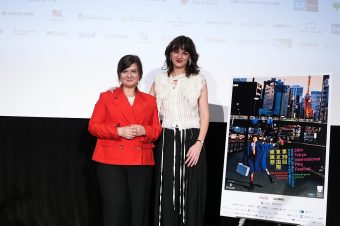
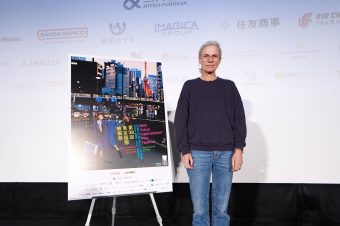
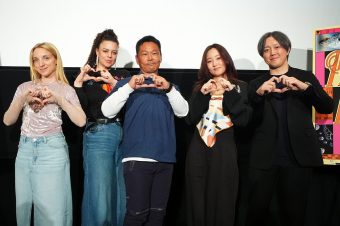
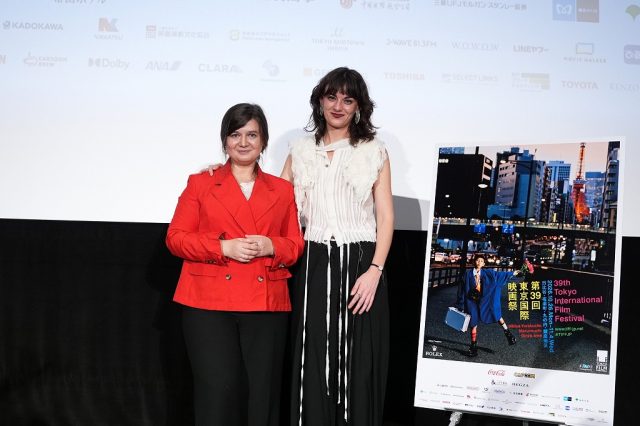
From left: Teodora Ana Mihai (director and screenwriter) and Violet Braeckman (actor) at the Q&A on October 26.
From left: Teodora Ana Mihai (director and screenwriter) and Violet Braeckman (actor) at the Q&A on October 26.
Making her third trip to the Tokyo International Film Festival after two earlier films, La Civil (2021) and Traffic (2024), had also been invited to the Competition section, director Teodora Ana Mihai brought her heralded new work, Heysel 85, to the 39th TIFF. On October 26, Mihai and her star, Violet Braeckman, took the stage after the Asian premiere to discuss the tense sports drama, inspired by the 1985 Heysel Stadium tragedy, with the audience.
Once the prolonged applause died down, the Belgian-Romanian director said, “I know it’s not an easy film to watch, but I hope you’ll find the subject matter important. Although the film was inspired by events that took place 40 years ago, I think there are many parallels with what’s happening in the world today.”
Told in the propulsive style of a thriller, seamlessly blending actual archival footage of the disaster with an increasingly intense (and mostly fictionalized) behind-the-scenes story filmed in handheld 16mm, Heysel 85 traces the state of “Thatcher’s Belgium” (as graffiti in the opening shot puts it) and the systemic failures that led to the near-incomprehensible outcome of the 1985 European Cup final, during which clashes between fans of Italy’s Juventus and England’s Liverpool resulted in 39 deaths and hundreds of injuries.
While the catastrophe galvanized the sporting competition industry and led to the implementation of much-needed reforms, it is still nearly impossible to imagine how it could have happened—how it could have been allowed to happen. Confining most of the action to the bowels of the crumbling Heysel Stadium in Brussels, interspersed with shots from the field, Mihai focuses attention on a poised young woman named Marie (Braeckman), daughter of Brussels’ fatuous mayor (like the other characters, a fictional or fictionalized figure), and a young Italian reporter from RAI, Luca (Matteo Simoni), who’s trying to find his family amid the chaos.
Marie is the mayor’s press attaché and soon his helpmate, as he begins drinking heavily and refuses to “make a fool of” himself by making the wrong decision, and so makes no decision at all. Hours after the deaths have begun to mount, there is still no statement from the Cup’s organizers or government officials. In heated arguments—which Marie, who’s able to speak French, English, Italian and Dutch, is called upon to interpret—the various sides blame terrorists, communists, the Italians and English hooligans for the violence (the local gendarmerie even insists it was the Pope’s fault, since he’d stretched the town’s resources during a five-day visit that had just ended).
TIFF Programming Director Ichiyama Shozo, recalling Japanese coverage of the tragedy, said, “At the time, I understood it simply as a violent confrontation between supporters of two opposing teams. But watching your film made me realize how many other issues were involved. There were ethnic and national tensions, questions about the stadium’s deteriorating infrastructure and the responsibility of public authorities, and, of course, the moral dilemma of whether the match should go ahead after the tragedy. I was deeply moved by how you brought all these complex issues together in a single film.
“How did you first become aware of the tragedy? Do you remember hearing about it when it happened, or did you learn about it later? And what made you decide to explore it as a filmmaker?”
Responded Mihai, “I was a bit too young at the time, and I was born on the other side of the Iron Curtain, so I didn’t experience the event as it unfolded live on television, as millions of people did that evening. My parents emigrated from Romania to Belgium in 1989, and I grew up with the trauma that the tragedy had left behind.
“I think you could say that Heysel is Belgium’s equivalent of 9/11. It affected people throughout the country. Belgium has Flemish-speaking, French-speaking, and German-speaking communities, as well as a large Italian community. Everyone was deeply shocked by what happened, and people are still talking about it today, 40 years later.
“Belgium is my adopted country, and I really wanted to make a very Belgian film. This story came my way, and that’s how the project came about.”
Ichiyama asked Braeckman about preparing for the role, in which she had to speak so many languages, but make it all seem natural. “Were there any particular challenges you faced in developing your character?”
“Language preparation is something very concrete that you can work on,” said the actor. “In Belgium, we tend to speak quite a few languages, so I already had three of them in my pocket. But I needed to work on my Italian. I went to La Piccola Università Italiana to become a little more comfortable and flexible with the language. Things can move very quickly on a film set, and you want to feel calm and confident when speaking another language. So that was something I worked on.
“Apart from that, Teodora and I talked a great deal. We didn’t have much time to prepare, so in some ways we just had to go with the flow. We had six languages being spoken on set, which was wonderful. That’s one of the beautiful things about Europe. We’re all neighbors, and our languages and cultures are closely connected, but each brings a different atmosphere and energy.”
Added Mihai: “This was a very impulsive project in many ways. We shot the film in just 25 days, which was a little crazy, considering the number of extras and the complexity of the production. We also lost some time because we insisted on shooting on 16mm film. We wanted to give the film the right visual texture and capture the atmosphere of the 1980s in every respect, from the music to the cars and the overall look. It was an enormous challenge to bring everything together in just 25 days.”
Echoing the thoughts of many in the audience, the first question came from a viewer who said, “It’s thrilling to encounter such a powerful and deeply affecting work on the opening day of the festival. I’m curious about the research you conducted—how much of the discussion and decisions were based on historical research, and how did you determine where to draw the line between documented fact and creative interpretation?”
Noting that there had been many “very good and highly informative” documentaries and TV reports, and that she also spoke with people who’d experienced the tragedy, she said, “I worked with two co-writers who were very knowledgeable about the subject. But what interested me most, and what I hadn’t seen explored very much in the documentaries, was the political thriller aspect of the story. I wanted to examine what happened behind those closed doors.
“Of course, we know certain details about what was said, but nobody can know exactly what happened in those rooms except the people who were actually there. That’s why it’s important to say that the film is inspired by real events. We took significant historical details and wove them into a fictional narrative. We tried to remain as faithful as possible to the essential events and major turning points. At the same time, we allowed ourselves the creative freedom necessary to make the story dynamic and emotionally impactful.”
Another viewer asked why Mihai had chosen not to combine archival footage with dramatized reenactments. Explained the director, “The archival images are engraved in the collective memory. Many people remember fragments of those images, and they’re incredibly raw and powerful. The real challenge was deciding which archival images to use and how to integrate them into the film in a way that was respectful rather than exploitative. Some of the images were so disturbing that, if we’d included them, they would have pulled viewers completely out of the film. So it was really a question of finding the right balance.”
Another viewer was impressed by how close the camera stays to the characters, although “the storytelling maintained a certain emotional distance from them. I felt that the film observed [them] almost dispassionately, without becoming overly subjective. Were you trying to portray the events as objectively as possible, despite the camera’s physical closeness to the characters?”
Said Mihai, “I’ve always liked getting as close as possible to my characters. I want the camera to enter their world and get close to their thoughts and emotions. But I think what you’re sensing is something that happens to people in moments of crisis. People can freeze. They enter an almost unreal state, as though they’re floating above the situation, unable to fully comprehend the enormity of the history they’re living through. I think that’s the feeling you’re describing.
“With this particular story, I realized during the writing process that it couldn’t be told through just one protagonist. Marie is the character who guides us through most of the film, but there are many other characters whose experiences are equally important. This is a story about many people, and I felt a responsibility to respect that. I needed to convey the full scale of what was happening.”
Said Braeckman: “Teodora and I talked about how we wanted to approach Marie and also the journalist, Luca. There was a very conscious decision to have these characters remain functional while everything around them was falling apart. They’re guiding the audience through the inner workings of the stadium and through the chaos of that night. As everything around her crumbles, [Violet] somehow manages to stay upright, partly, I think, out of respect for the victims.
“She’s not in a position of power. She can’t overthrow the system or make the major decisions. But she’s close enough to question what’s happening, navigate the situation, and act according to her own moral compass. I imagine that once she finally leaves the stadium, she’ll collapse. That’s when she’ll begin to process everything she’s experienced.
“But during that night, she has to keep functioning. I think that may be what creates the sense of emotional distance you describe. Under those circumstances, anyone would want to find a corner, break down, and cry. But Marie can’t do that.”
Mihai stressed, “It’s not her tragedy.”
Concurred Braeckman: “Exactly. She’s primarily an observer.”
Competition: Heysel 85
Q&A Guest: Teodora Ana Mihai (Director/Screenplay)










Recent News