


[Symposium] CROSSCUT ASIA+ SIDE BY SIDE in Time and Place: Archives in Becoming, Cinema Reopens History – Interconnections and Reinterpretations in Southeast Asian Cinema
© 2026 TIFF
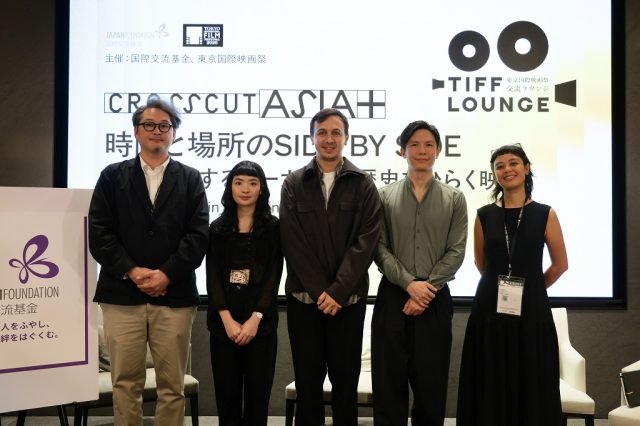
From left: Masayuki Ueda (Japan, film programmer), Raslene (Indonesia, film programmer), Daniel Mattes (Cambodia / USA, Producer), Daniel Hui (Singapore, Director) and Bunga Siagian (Indonesia, Researcher)
From left: Masayuki Ueda (Japan, film programmer), Raslene (Indonesia, film programmer), Daniel Mattes (Cambodia / USA, Producer), Daniel Hui (Singapore, Director) and Bunga Siagian (Indonesia, Researcher)
From 2014 to 2019, the Tokyo International Film Festival hosted a widely praised program dedicated to Southeast Asian cinema, jointly administered with the Japan Foundation, called Crosscut Asia. That program was halted due to the Covid pandemic and now been revived in a different form as CROSSCUT ASIA+. At the 39th TIFF, it debuted with a curated selection of six films from different eras and genres under the theme Side by Side, presenting Southeast Asia not as a unified whole but as a region in which unexpected connections can be found.
On October 29, the section’s two programmers, Ueda Masayuki from Japan and Raslene from Indonesia, hosted a symposium titled “Side by Side in Time and Place: Archives in Becoming, Cinema Reopens History.” The discussion explored Southeast Asian cinema through the role of archives in preserving fiction and documentary films in the region. The films that Ueda and Raslene selected for the section, working with advisor Markus Nornes, “examine how modern encounters can actively reshape historical meanings and reopen cinema to new possibilities,” according to their program notes. “When memories and archives meet the present,” as the notes put it, “questions arise about what is preserved, what is forgotten, and who shaped those boundaries. Cinema not only carries the past forward; it engages with the very process of remembering history.”
The curators invited three guests to describe their work in these matters: Bunga Siagian, an Indonesian cinema researcher who recently rediscovered the 1957 Indonesian film Turang, which was believed lost following the country’s anti-communist purges of the mid-1960s; Daniel Hui, a Singaporean director whose film Small Hours of the Night (2024) was selected for this year’s CROSSCUT ASIA+; and Daniel Mattes, the producer of Becoming Human (2025), a Cambodian film also screened in the section.
Ueda opened the symposium by pointing out that the six films “do not treat the past as something finished,” and encouraged the participants to reflect on what may have been left out of the national cinemas of Southeast Asia.
Raslene expressed specific interest in Turang (1957) and Small Hours of the Night (2024), since the former was, until 2023, a “lost film,” while the latter is a “reinterpretation of a lost event.”
Siagian noted that Turang has been a “lifetime project” for her, since she is the daughter of Bachtiar Siagian, the late director of the film.
“Turang was always the missing link in Indonesian cinema history,” she said. “At the same time, it’s an important piece of history itself. While doing research I found that the film had been shown at the Tashkent Film Festival during the Soviet era, so I contacted someone in Tashkent. The Indonesian government was of no help, so I had to rely on friends to help me make a network. And that’s where I found a print.”
For his part, Hui mentioned that Small Hours of the Night was related to his earlier film Snakeskin (2001), which had not been supported by the Singaporean government since it was considered independent leftist cinema. “It’s about an opposition party lawyer in the 1980s who ran against the ruling party,” he explained. “The lawyer has been erased from history in Singapore, and while Snakeskin is difficult to see in Singapore, Small Hours of the Night has been banned outright. The history described by both these films is effectively being erased.”
Mattes similarly said that Becoming Human, which is directed by Ly Polen and has become Cambodia’s Oscar® submission for 2027, focuses on indigenous minority groups as they address serious environmental issues that are occurring because of government inaction. “The director’s parents’ generation lived through the genocide of the Khmer Rouge,” said Mattes, “but in the 1990s there was a new force of oppression that transformed the landscape, and this film makes you aware of both the past and the present. The two eras of suffering talk to each other.”
Raslene asked how preservation could help, and Siagian stressed, “the past illuminates the current situation.” Her experience in finding Turang in Tashkent drove home the idea “that we have to continue the struggle” fought by her forebears, since it was their oppressors who effectively buried the film.
“Turang gives us an example of how to organize collectively,” she said. “At the time it was made, intellectuals used film as a tool for educating the public. When we look at how this film came about from today’s vantage point, it’s not only inspiring but instructive of how to do it. It’s not just a matter of restoring old films, but rather a matter of learning how we should be living our lives.”
Mattes pointed out that Cambodia’s film industry is still relatively young, “having only hit its stride in the 2010s.” Up until then, it was almost all about director Rithy Panh, a renowned chronicler of the cruelty and terror of the Khmer Rouge. “Now you have more multiplexes opening in malls in Cambodia, but the country still lacks a cinema infrastructure. Consequently, young directors have had to look outside Cambodia to study filmmaking, and I’m not sure if that is sustainable. My company gives voice to the desires and perspectives of a new generation who thinks film is the right medium to focus on social change and dealing with traumas that are the result of government actions; but it’s always based on issues from the past.”
Hui said he saw how the past directly influenced his present attitude toward his country after watching a film about Singapore in 1904 at a festival in Bologna. “The images were of a procession in Chinatown in which Chinese and Indians participated together in unity,” he recalled. “Nowadays, those two groups are totally segregated, so seeing a film in Italy about the place where I live now had a huge emotional impact on me. I saw how cinema is a valuable tool, and that films about the past can also be about the future.”
Raslene wondered whether archives could provide spaces where “the present can be confronted—which stories are now on the record and which are unrecorded due to political influence?”
Siagian noted that when you “activate” an archive, you often get epiphanies like the one Hui experienced in Bologna. “You see a past that should be a reality today but isn’t,” she said. “To understand the cycle of history is to empower the collective with more agency to stop the violence. Engaging with archives is not merely a romantic practice; it is activism. When I premiered the restoration of Turang in Indonesia, it became collective activism, because it was shown all over the country. People discussed it in the context of demilitarizing the nation.”
“The state often prefers a narrative that suits it,” Mattes added. “So inside that archive the state may erase or void some things. That’s how power works, intentionally or not. I’m not sure if Cambodia’s film archives were actively purged after the Khmer Rouge fell, but we need to know what life was like during that time. For a while Cambodians made no films and were just rebuilding their society.”
Said Hui, “When I made Snakeskin, I went to the Singapore film archives and there were no images of the topic I wanted. That’s why we have to take that archive into our own hands, otherwise it can be weaponized against us.”
Ueda asked Hui how the present could be depicted in the future.
“We have to make decisions to safeguard archives for the future,” he replied. “That means being a responsible filmmaker. It’s a way of redistributing power. Make the archive accessible to anyone, even those outside of Singapore.”
Raslene emphasized that it shouldn’t be about controlling the future, however.
Mattes said that in the archive he runs, “we can see how drastically things change in a short time; there are films from 2015 that depict things that don’t exist anymore. Only ten years ago, filmmakers in Cambodia were effectively making time capsules.” He added that Southeast Asia in this regard shouldn’t be thought of as monolithic. “It’s something of a cliché for international critics to say that a film about Cambodian women could relate to the larger world, but it’s something we should work with. Archives should definitely say something about how we live today.”
Siagian suggested that post-colonial filmmakers had to come up with their own cinematic language “in order to best serve their own people and history,” and that language has to be passed down, obviously through archives. Otherwise, regional cinema becomes homogenized as world cinema. “When we talk about Southeast Asia we see this romantic idea of diversity, but we should move beyond that idea to take collective action for our future.”
Hui countered that you cannot understand Singapore without first understanding the whole history of Southeast Asia, including “its labor and politics.” The West, he noted, is only now coming to terms with this reality. “We have to confront this new form of imperialism,” he said. “In the 1950s we talked about the non-aligned movement. We should continue that struggle.”
“Transnational solidarity,” said Raslene.
As an American living and working in Cambodia, Mattes sees this aspect up close. “I have that former colonial gaze that makes me ask myself how I can support others,” he said. “My story is common in Cambodia, because the UN effectively ran the country after 1991, with a lot of help from Japanese civil servants. But the reality today is that the freedom promised by the new constitution is controlled, mainly by outside forces that tell the country what to do. It’s like a new colonial structure. It’s been only recently that filmmakers and musicians have made their own contributions. How do you cultivate a cinema that serves the desire to be seen on its own?”
Returning to the topic of cross-border possibilities, Hui commented that his career as a film editor—the work that financially supports him—has mainly been on coproductions. “I’ve worked in Thailand and Vietnam because the Singapore government set up a coproduction fund that allowed me to get hired,” he said. “And if I can’t find money to make films in Singapore, maybe I can get funding from the Philippines.”
The flipside of this “solidarity,” he pointed out, is pushing blame over borders, and cited the plight of the Rohingya refugees from Myanmar as an example, since most of the countries they’ve fled to are trying to send them back.
“In Cambodia, we have no funding,” said Mattes, “so we’re dependent on France or Germany or even Singapore. We have technocrats telling us how a movie should end, which is strange. That’s why it’s important for filmmakers to [also] engage with small cinema events in the region rather than [just] big, industry-driven film festivals—that’s where you find the transnational energy. The programs at the Busan and Tokyo film festivals create opportunities for these filmmakers to connect with one another and find new sources of inspiration.”
CROSSCUT ASIA+Co-organized by: the Japan Foundation
[Symposium] SIDE BY SIDE in Time and Place: Archives in Becoming, Cinema Reopens History
Panelists: Bunga Siagian (Indonesia, Researcher), Daniel Hui (Singapore, Director) and Daniel Mattes (Cambodia / USA, Producer)
Moderators: Masayuki Ueda (Japan, film programmer) and Raslene (Indonesia, film programmer)














Recent News