


”Sister Brother Manhole Cover” Q&A – A Copacabana of the Mind in North Macedonia
© 2026 TIFF
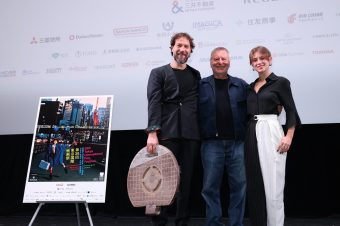
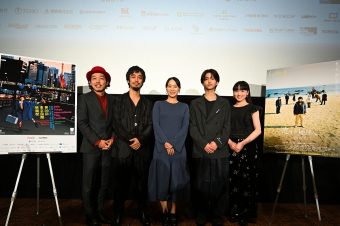
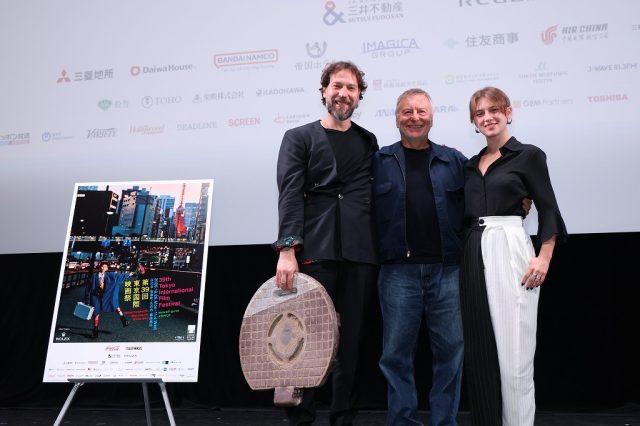
From left: Filip Trajkovikj (Actor), Milcho Manchevski (Director/Screenplay) and Sara Klimoska (Actor)
From left: Filip Trajkovikj (Actor), Milcho Manchevski (Director/Screenplay) and Sara Klimoska (Actor)
Director Milcho Manchevski’s latest film, Sister Brother Manhole Cover, had its world premiere October 30 in the Competition section of the 39th Tokyo International Film Festival, in front of a large and exuberant audience that seemed well-versed in his work. The Macedonian-American filmmaker, who debuted in 1994 with the Golden Lion-winning, Oscar®-nominated Before the Rain (1994), also premiered his last fiction feature, Kaymak, at TIFF in 2022.
Befitting the cleverly rhymed title, the movie is a bittersweet fairytale about a pair of poor siblings who steal manhole covers and memorial busts of famous people off the streets of Skopje, North Macedonia, to sell for scrap. After the older brother, Viktor, who is developmental disability, drops a bust on his foot and seriously injures it, he and his very protective sister, Malina, struggle to navigate the criminal underground in order to get medical care for him. They eventually end up in the palatial home of a blind female doctor whose ministrations Malina initially finds suspicious.
Asked how he came up with such an unusual story, Manchevski explained during the post-screening Q&A session, “In the park near my house are busts of national heroes that have been there since I was a child, but a few years ago only the pedestals remained. Even after the original busts were replaced by replicas, those disappeared as well. I did some detective work and found that a kilo of bronze went for 3 euros at the scrapyard, so I decided to tell this story from the perspective of the thieves.”
Manchevski went on to say that this perspective forced him to find a reason for the larceny. “I saw [the thieves] as part of a society that had forgotten the heroes of the past,” he said. “So it’s a film where nothing is as it seems—the anti-heroes are sometimes the heroes. It’s really a story about one of the biggest issues in the world right now, the wealth gap. But I didn’t want to lecture the viewer. I wanted to focus on the humanity of the characters and the humor, which is the path of least resistance.”
Manchevski was joined on stage by the actors who played the siblings, Sara Klimoska and Filip Trajkovikj. When asked if the role of Malina was challenging, Klimoska said, “Well, there were three weeks of rehearsal and we had a lot of fun doing it, which is important, because regardless of what happens to the characters, they never forget to have fun.”
Trajkovikj explained that he went the extra mile, because his character required more research. “I started preparing two months before the shoot,” he said. “I had to find out about people on the spectrum. Once I learned more about them, then it became easier to play Viktor, because I could understand what the character wanted.”
One audience member who has seen a number of Manchevski’s films said that he found them “novelistic” and wondered if he provided his actors with outside materials to read before the shoot.
“I love doing research,” the director admitted, “and I try to involve the cast and staff in that research. While some appreciate it, others find it silly. In this case, the purpose of our research was to make the characters more human by exploring their social circumstances in detail. This was particularly important with Viktor. We wanted to do justice to him by portraying the person rather than the condition.”
One viewer noticed the movie’s allusion to the Brothers Grimm story Hansel and Gretel, with the rich blind doctor standing in for the witch who lures the siblings into her home with cookies. Malina and Viktor’s fate, however, turns out to be slightly different. The viewer, however, was more interested in a dance that Malina performed and wondered if it was improvised.
Klimoska said the dance was in the script, but it was simply described as being “odd.” Manchevski added that it was mostly improvised but that he directed Klimoska to make her movements “angular.”
Another overarching motif in the movie is Brazil, in particular Copacabana beach and the Christ the Redeemer statue that looks out over Rio de Janeiro.
Manchevski explained that these references spring from Viktor’s imagination. “Viktor loves football, and his hero is Ronaldo, who he mistakenly thinks is Brazilian (he’s Portuguese). Also, the slum where Viktor and Malina live is called Copacabana because the residents want to imagine that they live in a tropical paradise. We took this metaphor a step further in the dream sequence that’s structured as a TV commercial featuring the Christ the Redeemer statue. We can do that in movies.”
The last question returned to Hansel and Gretel, specifically the rich doctor’s residence in the story.
Manchevski explained that, in keeping with the idea that nothing is as it seems, he had deliberately left the character’s motives vague. “She at first seems intimidating,” he says. “And then we get to understand the complexity of her personality. She’s tough but forgiving. She doesn’t waste words. Ultimately, she helps the siblings and herself by building a new family, which, when you think about it, is something you create. And that’s the secondary theme of the movie, after the one about social inequality.”
Competition: Sister Brother Manhole Cover
Q&A Guests: Milcho Manchevski (Director/Screenplay), Sara Klimoska (Actor), Filip Trajkovikj (Actor)















Recent News