


“Silver” Q&A – A Young Teen Takes a Hero’s Journey
© 2026 TIFF
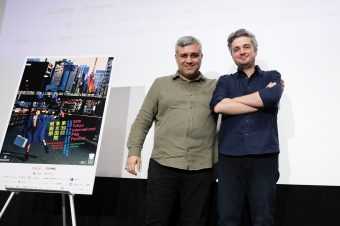
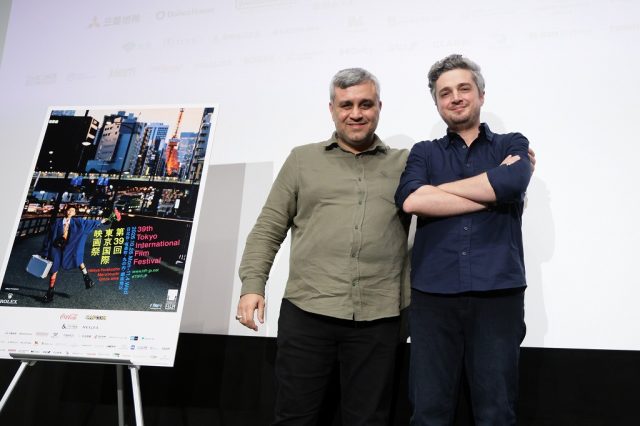
From left: From left: Mohammad Gharakhanlou (Producer) and Soheil Karimi (Director)
From left: From left: Mohammad Gharakhanlou (Producer) and Soheil Karimi (Director)
Fans of Iranian cinema will be familiar with the many masterworks centering on children by the likes of Kiarostami, Panahi, Majidi, Naderi and more. With Silver, Soheil Karimi suggests he may soon join their ranks. Following the film’s world premiere in the Asian Future section of the 39th Tokyo International Film Festival on November 1, the director was on hand to discuss his latest feature, along with producer Mohammad Gharakhanlou, in a spirited Q&A session.
In the beautifully lensed, wonderfully acted Silver, young teen Sasan (Parsa Sigarchi) is forced to grow up nearly overnight when his well-meaning decision to help a girl in his village backfires rather spectacularly. Sasan, who dutifully feeds the chickens and ducks, then packs oranges before going to school each day, has a crush on his classmate Maryam. After learning that her mother needs to be hospitalized and the family must sell their only dairy cow to raise money for her treatment, Sasan is determined to help in some way. Early one morning, after much deliberation, he takes his great-grandmother’s silver necklace from its hiding place, and goes to the nearest town to sell it.
At the bazaar, the boy is swindled despite his wariness, and after chasing the peddler who has tricked him, finds himself lost. He receives a fortuitous phone call from his soldier brother’s girlfriend, Nazanin (Masha Bavafa), who effectively comes to his rescue. But Nazanin also has her own problems, as does her roommate, who’s trying to use her parents’ life savings to help her brother, stuck in Turkey, to immigrate to Italy for work. The women do what they can for Sasan, including treating him to a hamburger, before putting him on the bus back home the next morning. There, he discovers the entire village is calling him a runaway, and his mother is so disappointed about his thievery that she won’t talk with him. But Sasan has a secret, and it has transformed his entire view of the world… and more importantly, of himself.
Moderator Ishizaka Kenji, TIFF Senior Programmer, kicked off the Q&A session by asking about the choice and the meaning of the film’s title. Explained Karimi, “In our culture, silver carries a certain sense of nostalgia, but it is generally considered less valuable than gold. I wanted to turn that idea around. In this film, silver becomes the most precious and meaningful thing. It has the power to bring people together and create a sense of closeness and connection. That is what makes it so valuable.”
Not surprisingly, the first question from the audience concerned the young actor playing Sasan, whose face is particularly expressive. “Could you tell us how you directed him?”
Said Karimi, “We considered around 200 boys for the role of Sasan. The one we eventually chose was exceptionally bright. He had never acted in front of a camera before, but from the very first day he learned everything remarkably quickly. He was a pleasure to work with. Each day, we would spend about 15 minutes discussing the scenes we were going to shoot. He understood the character and immersed himself in the role very naturally. His family was also extremely supportive, which made our work much easier.”
Another viewer asked about Sasan’s clothes: “For roughly the first 80 percent of the film, he wears very simple, almost rustic clothing. But when he returns from the city, he looks a little more fashionable. His T-shirt also has the word ‘brutal’ printed on it, which seems to describe the harsh experiences he has been through. Was that intentional?”
Clearly pleased that this had been noticed, Karimi replied, “The story follows a young boy who has spent his whole life in a small, enclosed village and then sets out on a journey. I see it as a kind of hero’s journey. He returns having suffered setbacks and failures, but the experiences he gains will have a lasting impact on his life. He comes back a different person from the boy who had never ventured beyond his village.”
Another audience member noted that the village’s adult men treat the boy “very harshly,” and yet when he meets the two women in the city, they are kind to him. He wondered, “Was it common, especially in the past, for men to be so strict with children?”
“Yes, that was quite common in the past, particularly in the way fathers and other men treated boys,” said the director. “Women tended to be gentler with them. It was part of the culture at the time, although attitudes have gradually changed. I don’t think fathers today are generally as strict with their sons as they once were. That was also my experience growing up. If you were a quiet, well-behaved boy, you might avoid that treatment. But if you were energetic or mischievous, the men around you, including your father, could be very severe.”
Pointing out that Karimi’s previous films have dealt with subjects like migration and illness, another viewer wondered whether the shift to a child’s story had been influenced by the “current economic and social situation in Iran” or whether it had come from personal experience.
The director confessed, “This is a very personal film for me. Living in a country going through such difficult times, I felt a strong desire to escape, at least for a while, to find some kind of refuge. I wanted to return to a quieter, gentler time, when people seemed less tense and less anxious. I’ve made socially engaged films before, and many filmmakers are still making them. But with this project, I wanted to reconnect with something more fundamental in myself, with a time when the world felt less complicated. In that sense, I think this film was also a way of comforting myself.”
Noted another audience member, “There are several absent fathers and brothers in the film. Maryam’s father is not at home, and other male family members are missing or have gone abroad. Is that absence intended to symbolize something?”
Said Karimi, “When I was writing the screenplay, I deliberately wanted to explore families in which a father, brother or another man who would traditionally be considered the head of the household was absent, either temporarily or permanently. That idea may well have come from my own childhood. My father was frequently away from home for work, sometimes for long periods. I had a younger sister, and I was often told that I was now the ‘man of the house.’
“I was expected to protect the family and take on responsibilities that would ordinarily have fallen to an adult man. I think those experiences helped shape the story. I also wanted to show how difficult life can become for women and children when the person they depend on is absent, whether for a short time or for good.”
Asked about the biggest challenges in making the film, producer Gharakhanlou said, “We shot in northern Iran, near the Caspian Sea. None of us were from that region, so we weren’t familiar with the local conditions. It’s also a very popular destination, particularly in the summer, and that created additional difficulties. We filmed toward the end of the summer.
“Preproduction took roughly three years, during which we made several attempts to get the project underway. When we finally began shooting, we spent about a month away from our families, working in that region. Postproduction then took another six months, with various obstacles along the way, before we could finally complete the film.”
Gharakhanlou went on to express thanks to everyone who worked on Silver, “especially our wonderful cinematographer, Sattar Goudarzi, who worked incredibly hard. The shoot was very demanding. We had exceptionally heavy rain, and from about the second day onward, everyone was getting sick. They took medication, received treatment, and somehow managed to return to work. Despite the illnesses, the rain, and all the other difficulties, everyone kept helping until the end. I’m grateful to every member of the team, and I hope this film marks the beginning of many good things.”
Karimi concurred, “I also want to thank every member of our cast and crew. I’m especially happy that, after such an extraordinary and difficult year for Iran and for Iranians, we were able to make it here.”
Asian Future: Silver
Q&A Guests: Soheil Karimi (Director) and Mohammad Gharakhanlou (Producer)














Recent News