


Women’s Empowerment Talk “HER GAZE” – Ready for Their Closeups: Two Cinematographers Talk Shop
© 2026 TIFF
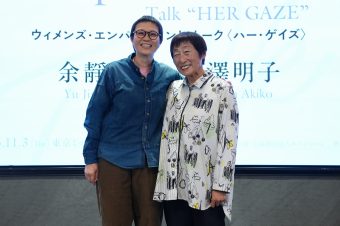
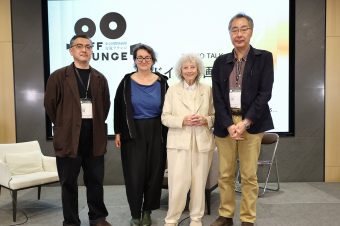
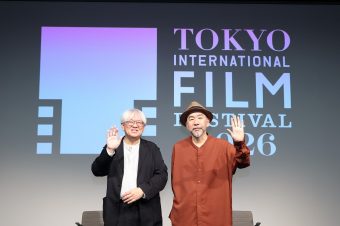
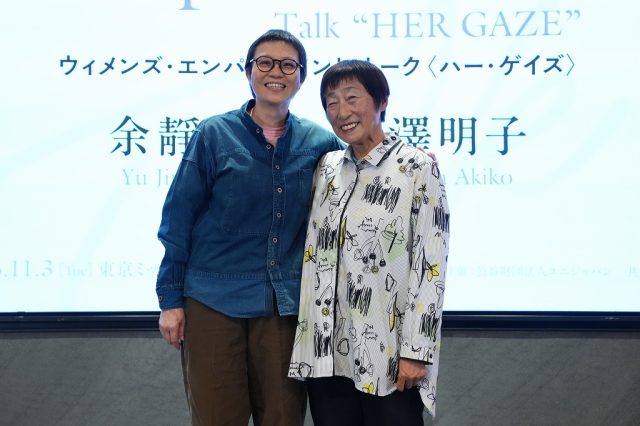
From left: Yu Jing-pin (Director of Photography) and Ashizawa Akiko (Cinematographer)
From left: Yu Jing-pin (Director of Photography) and Ashizawa Akiko (Cinematographer)
Before the Women’s Empowerment Talk “Her Gaze” started on November 3 at the 39th Tokyo International Film Festival, there was an announcement alerting the audience that they might hear the cries of children in the background, since free childcare was being provided for the attendees. It was a particularly fitting addition to the event, which was about working women, specifically women who work in the more technical fields of the film industry.
TIFF programmer Kondo Kanako, moderator for the discussion, explained that she’d chosen the title “Her Gaze” because the talk was to delve into the work and approaches of two of the most successful female cinematographers in Asia, Yu Jing-pin of Taiwan and Ashizawa Akiko of Japan.
She noted that, according to the World Economic Forum’s latest Global Gender Gap Index, Japan ranks 117th.
“Last year, with the help of Taiwan’s Women Make Waves International Film Festival, we looked at the proportion of theatrical feature films directed by women,” said Kondo. In Taiwan, the figure was just under 30 percent, compared to around 10 percent in Japan. Although the two countries differ considerably in the scale of their film industries, the disparity in the proportion of women directors is striking.”
Yu told the audience that she had started her career as a still photographer in art, fashion and advertising. In the 2000s she moved into film and has worked with many of the Chinese-speaking world’s major directors, winning awards in both Taiwan and Hong Kong.
She said that she was always a movie fan, and while watching films she would “study individual scenes very carefully. I would count how many times the shot changes within a scene.”
Since this was in the days before digital media, she satisfied her curiosity by taking photos, having them developed, and then arranging them on the floor to make a kind of story. “I studied how one shot connected to another,” she said, “and why the camera angle changed, and what each shot contributed to a scene.”
She felt that still photography was always about storytelling, even when she was doing fashion shoots. “I was once assigned a six-page fashion spread,” she said, “so I considered the model’s pose on the left-hand page and how the composition on the right-hand page should relate to it.”
This visual-conceptual sensibility naturally led her to cinematography, while she continued working as a still photographer. She said, “For me, still photography is like exchanging gifts—the subject is simple and direct. Cinema, on the other hand, is like reading a long novel, in that you have to interact with many different people, events and objects.”
Kondo asked which aspect of the making of a movie most concerns her, and Yu answered, “I place enormous importance on the structure of the screenplay. The development of the story gives us the foundation for imagining all kinds of visual possibilities.”
The more imaginative the screenplay, the freer she feels about the images. “When director Shu Qi first gave me the screenplay for her movie Girl, I thought it was like poetry,” Yu said. “She had written down feelings rather than detailed descriptions of the action.” Of course, matters became more concrete as the film developed, but that initial impressionistic script fired Yu’s imagination.
She also believes completely in thorough preparation. “I test cameras, lenses and other equipment according to the needs of the story,” she said. “I don’t know if that has anything to do with being a woman, but I’ve developed my own way of organizing things.” She does not rely on storyboards, instead setting up a shooting plan for each scene.
Another important factor is color, for which she creates look-up tables in order to establish a film’s basic visual tone. “For each project I make five to eight LUTs so we can explore all the possibilities and make choices.”
Regardless of the amount of planning, the circumstances of the shoot dictate what can and cannot be done: “There are things you simply cannot control.”
For instance, budgets, which in Taiwan can be precarious. She realized these limitations when she worked in Hong Kong and China, where productions are much larger.
Due to these financial constraints, Yu says she’s become quite adept at handheld cinematography. “It allows me to respond very quickly to actors and the environment around me,” she said. “When time is limited, I can pick up the camera and immediately begin filming what I want.”
Kondo commented that she’s always noticed how close Yu gets to her actors, maybe more so than other cinematographers.
Yu recalled working with Derek Tsang on the box office hit Soul Mate, and realizing during the editing that the director mostly chose closeups. Later, when they worked together on another film, Better Days, she was able to meet Tsang’s expectations in a more efficient way. “I decided to use relatively wide-angle lenses while moving close to the actors,” she said.
Yu described a set where she was filming with real film, and the actor was performing a particularly emotional scene. “I was holding the camera very close to her while she was crying,” Yu said. “At the same time, she was actually moving the cables [for the camera] out of the way for me, because otherwise I might have dropped the camera. When I’m working handheld, I can sense what the actor is thinking, even beyond the script.”
This kind of empathy has lent Yu a reputation among actors as a cinematographer who makes the shooting process less intrusive. “They’ve become accustomed to my presence,” she says.
Kondo commented that Taiwan has undergone significant social changes over the last 25 years, including efforts to promote gender equality. Have those changes been reflected in the film industry?
“For me, the difference between female and male crew members has never been the most important consideration,” Yu replied. “What matters is knowing what I can do, how well I can do it, and what I can contribute to the film.”
Kondo asked if working conditions for women in Taiwan’s film industry have changed, mentioning that, in Japan, more women are entering technical departments as cameras and lighting equipment become smaller and lighter.
Yu recalled that the first time she encountered a female lighting technician was actually in Japan. She happened to be in Okinawa photographing an album cover for a musician and noticed a nearby movie shoot. There were a lot of female technicians.
“I don’t think there are enough women in technical departments in Taiwan,” she added. “My impression is that Japan may actually have more.”
At that point, Kondo brought out the other cinematographer on the bill, Ashizawa Akiko, who she described as “a pioneer who helped open the doors for women cinematographers in Japan’s traditionally male-dominated film industry.”
Asked what she thought of Yu’s comments, Ashizawa said that she’d found much of what she said “deeply moving.”
“We only met 30 minutes ago,” Ashizawa said, “but I feel that we belong to the same world. We have so much in common.”
Kondo asked Ashizawa to talk about the changes in working conditions in the film industry, including guidelines limiting working hours. Starting around 2000, said Ashizawa, conditions improved to “make the industry more accessible to women,” and the situation for women has become much better.
“These days, more than half the crew members are usually women,” she said. “The fact that there’s a daycare facility here for the talk is almost like a dream to me.”
Kondo asked Yu if there are women in Taiwan who work in the film industry while raising children. “There are quite a few directors who do,” she replied.
Ashizawa emphasized that the support of colleagues is essential to making such a system work.
She mentioned that when she spoke at the 2025 Asian Women’s Film Festival in India, she’d asked the organizer if it was really necessary to include “women’s” in the title of the festival, since she though it sounded outdated. The organizer replied that they would continue using the name until “certain attitudes disappeared.”
“In many parts of Asia, women still face prejudice simply for wanting to participate in filmmaking,” said Ashizawa, “and I understand that completely, so I was very glad I participated.”
“That’s one of the valuable things about international film festivals,” said Kondo, “since they offer venues where women from different countries can share their experiences.” She then mentioned the Afghan filmmaker Shahrbanoo Sadat, who was attending TIFF. “She explained that in Afghanistan, the very act of a woman making a film can be considered problematic.”
Kondo asked Yu if there were women-focused festivals in Taiwan and Yu said that there were. “There are also events that invite women directors to Taiwan for discussions and exchanges,” she added.
Ashizawa and Yu then commenced a lively discussion about technical matters that the audience found amusing, including handheld versus fixed camera usage; the variety of lenses they preferred, not to mention the manufacturers; and the use of tripods.
They even talked in detail about shadows. Yu asked Ashizawa about Tokyo Sonata, in which she “used people’s shadows and reflections in very interesting ways” that also struck her as being difficult technically.
Ashizawa said she works with an independent lighting director. “I only handle the lighting myself on smaller productions. Tokyo Sonata had its own lighting director.”
One audience member asked the two cinematographers if they ever included unscheduled shots in the movies they were making.
Ashizawa replied, “Even after principal photography has finished, I sometimes feel there’s something missing and decide to shoot additional material. I’m constantly causing trouble for the people at the laboratory.”
Another audience member asked about storyboards, since many younger directors insist on them. In that case, “How do you preserve your own creative freedom as cinematographers?” he asked.
Ashizawa answered, “I think the cinematographer’s job is to give concrete visual form to what the director has in mind. When I work with directors who love storyboards, I study them carefully, but I always add one thing: Let’s use the storyboard as our foundation but try to add things that aren’t in them.”
The questioner also asked about underwater photography, since he’d heard Ashizawa actually took swimming lessons in order to do underwater photography, a story Ashizawa confirmed.
“I actually learned underwater cinematography myself,” Yu interjected. “Sometimes I need underwater shots, but the specialists couldn’t achieve exactly what I wanted, so I obtained a diving license.”
Asked what they thought was the most important aspect on set, Ashizawa immediately replied, “Concentration, because unexpected things always happen.”
Yu agreed. “Making a film is like sailing a ship: the director is the captain and the cinematographer is at the helm. You have to remain focused.”
Ashizawa said she had issues with people who always say things can be fixed in post-production. “I tell them that being able to do anything afterwards might mean not being able to do anything at all.”
Another audience member mentioned that filmmaking can be quite difficult physically, and wondered how the two women maintained their stamina and strength. Ashizawa said she unwinds by watching golf on television, which gives her tips on building up her “mental strength.” Yu countered that she prefers watching tennis.
When asked what advice she would give to aspiring cinematographers, Ashizawa said, “I think it’s important to be able to communicate with others. The process of exchanging ideas and collaborating with different people can lead to better things. Also, don’t limit your interests to film. Look at paintings and other forms of art.”
In closing, Yu said, “I think Akiko is the real pioneer here. I’m simply someone who has been fortunate enough to have my hard work recognized. But to all the women working in the business, I have to say this: Don’t doubt yourselves. Believe in yourselves and prepare as thoroughly as you can. One day, the world will open up and embrace you.”
Women’s Empowerment Co-hosted by Tokyo Metropolitan Government Produced by Kondo Kanako
Women’s Empowerment Talk “HER GAZE”
Panelists: Yu Jing-pin (Director of Photography) and Ashizawa Akiko (Cinematographer)
Moderator: Kondo Kanako (Programming Group, 39th Tokyo International Film Festival)











Recent News