


[Animation Symposium] Women Directors- Diverse Visions – Paving the Way for the Next Generation
© 2026 TIFF
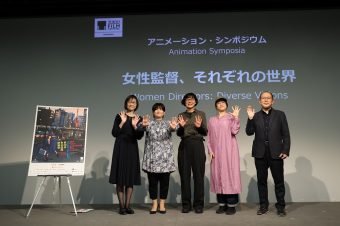
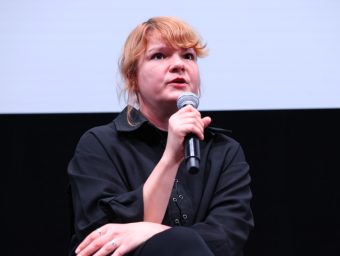
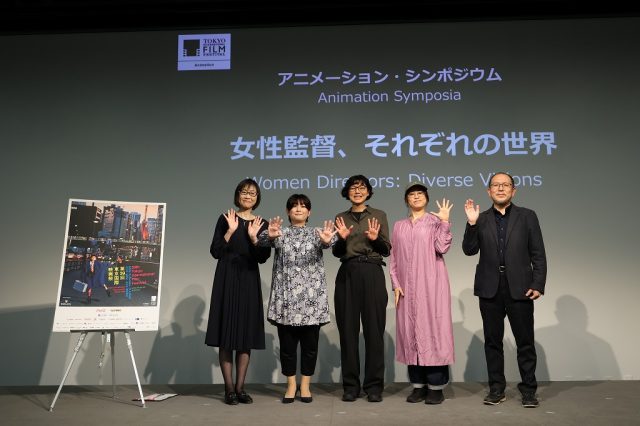
From left: Sugawa-Shimada Akiko (Professor, Yokohama National University), Nagaoka Chika (Director), Watanabe Kotono (Director), Yoshimura Ai (Director) and Fujitsu Ryota (TIFF Animation Section Programming Advisor)
From left: Sugawa-Shimada Akiko (Professor, Yokohama National University), Nagaoka Chika (Director), Watanabe Kotono (Director), Yoshimura Ai (Director) and Fujitsu Ryota (TIFF Animation Section Programming Advisor)
While women are gaining more opportunities than ever within animation to showcase their talent in leadership roles and as directors on major projects, equity has yet to be reached. Recognizing how far things have come, as well as how far there is still to go, a symposium entitled Women Directors: Diverse Visions was held at the 39th Tokyo International Film Festival to address what can be done to reach the goal of parity. On November 1, three prominent Japanese women animation directors sat down with Sugawa-Shimada Akiko, a professor at Yokohama National University, to discuss their careers, what inspired them to enter the field, their other roles, and the challenges of being a director in one of Japan’s fastest-growing global industries.
The 1980s marked an important period in the emergence of female anime directors in Japan, although their numbers did not begin to grow significantly until the 2000s. While more women have been promoted to producer, lead animator and other roles in production, both inside and outside Japan, the percentage of female directors remained below 10% in 2022, according to the Japan Film Project.
The symposium brought together Nagaoka Chika, whose 2019 film Detective Conan: The Fist of Blue Sapphire was the franchise’s first feature directed by a woman; Watanabe Kotono, director of 2023’s Gold Kingdom and Water Kingdom; and Yoshimura Ai, who directed last year’s musical adaptation of the landmark shojo manga The Rose of Versailles.
Beginning proceedings, Sugawa-Shimada asked the women what it meant to be a female director working in the industry today. Though each that her position was still a rare one, none viewed her work as being defined by her gender, and all said they always attempted to create the best film possible.
“For me personally, I don’t often think that because I’m a female director I’m going to do something differently when I do my work,” explained Yoshimura. “That being said, sometimes I have people tell me later that it was because of my female direction that the film turned out the way that it did.” Asked how she felt about hearing that, she added, “I don’t mind too much, but I think it’s more that I do what I want to do and approach things the way I feel is best for capturing the story I want to tell. People may tell me that objectively it’s the female perspective, but that’s not necessarily how I feel.”
However, the directors did concede that varied lived experiences may lead them to pick up on aspects of a work differently from a male director. This, combined with other circumstances such as whether a work is targeted at a predominantly female audience, can make a female director a stronger choice to lead a film. Indeed, as Watanabe noted, some creative teams are even seeking out this perspective at times when the target audience of a film may be particularly receptive to it.
“When a new work is being commissioned, you sometimes hear requests like ‘we want to have a female director,’” she noted. “Since anime based on shojo manga tend to have a larger female audience I think this is a good thing, as it shows they want someone who can capture specific points they want to highlight from a female perspective.”
In the case of The Rose of Versailles, the series has a strong female audience as well as many other adaptations in various mediums, including for the stage by the Takarazuka Revue theater troupe. This is something that director Yoshimura considered deeply while planning how to adapt the series for the big screen. Though she admits it was challenging, it came more naturally to her than some work did during the early days of her career at anime studio Sunrise, known for mecha anime like Mobile Suit Gundam. Yoshimura admits that even now, she has not seen the series herself.
“There were many people who said they’d planned to do a film adaptation of The Rose of Versailles who were later unable to do it, so when it came to me I felt a lot of pressure,” admitted Yoshimura. “Actually, I was initially asked what sort of work I would want to try, and I said I was a fan of the series. After it was decided that I would work on it, I felt a lot of pressure because it was such a long series with so much history and many fans. I wanted to ensure I preserved the original themes and meaning of the story, and for that I interviewed Ikeda Ryoko, the original author. From that I determined that a big theme in the story was the idea of both Oscar and Antoinette, as well as everyone else, establishing what it means to live for their true feelings. So I developed the story of the series into this theatrical version from that. I also built the music and songs from that idea.”
For Nagaoka, who directed The Fist of Blue Sapphire, working to a deadline brought a lot of pressure, but she felt that her work on this series and others had shaped her creative style. “I think it’s important not to move too far away from the character identity created by those who worked on the series previously,” Nagaoka noted. “I’m sure everyone has their own image in their head of who Edogawa Conan is, and while I’ll maintain that character other people have created, I’ll also include a bit of my own vision of Conan into the work.” She later added that, owing to her experience working on Detective Conan and other franchises like Gintama and Uta no Prince-sama, “I’ve been able to develop my own distinctive style of directing.”
Throughout the talk, the women stressed that gender is not a weakness in their eyes, and that the experience of developing these works is much the same for male and female directors. Being a female director doesn’t make someone less qualified, they noted, as women still have to overcome the same challenges regarding storyboarding, adaptation and more that male directors would also face. What has held women back instead, they suggested, are the broader social expectations about their lives beyond work, especially when it comes to raising children. But, attitudes are changing as studios make efforts to support female directors, including Madhouse (the animation house behind Gold Kingdom and Water Kingdom (2023)).
“After giving birth, I thought it might be impossible to keep directing, but the studio told me they would support me, so I thought, why not give it a try,” Watanabe recalled. “Thanks to the support of both the company and my partner, and since my child seemed to be able to [cope well with] that life for a year, it worked out. It felt like it was a stroke of luck, but whether a project like this can even succeed when going through these life circumstances depends on the support of people around you.”
This was an important point emphasized as the floor opened up to audience questions. Changes in attitudes within the industry mean that it is now possible for women like Watanabe to keep directing while raising a child. When an aspiring animator in the crowd asked for advice about rising in the industry to such a position, it felt notable that the advice given focused more on the creative skills necessary to succeed in the role. Historically, women seeking directorial and senior positions have faced pressure to make sacrifices and conform to an industry whose most prominent creative voices have largely been male, with no guarantee of being elevated to the same positions of authority. The situation is shifting.
As the talk wound to a close, a sense of camaraderie had developed the panelists. Though they had shared similar experiences and were of the same generation, they admitted they had not met each other prior to this event. The trio seemed eager to continue the conversation after leaving the stage. “We’ll have to add each other on LINE and plan a women’s party sometime!” exclaimed Yoshimura before the talk ended.
The conversation on increasing the number of female directors in animation will continue. And hopefully, more women will receive the opportunities they deserve to direct the next wave of animated feature films.
AnimationAnimation Symposia
Women Directors: Diverse Visions
Panelists:
Nagaoka Chika (Director)
Watanabe Kotono (Director)
Yoshimura Ai (Director)
Planning: Fujitsu Ryota (TIFF Animation Section Programming Advisor)
Moderator: Sugawa-Shimada Akiko (Professor, Yokohama National University)
Nagaoka Chika, Director of Detective Conan: The Fist of Blue Sapphire
Watanabe Kotono, Director of Gold Kingdom and Water Kingdom
Yoshimura Ai, Director of The Rose of Versailles









Recent News