


TIFF Lounge Tokyo Talk: An Evening of German Cinema – Redefining the Map of German Film History
© 2026 TIFF
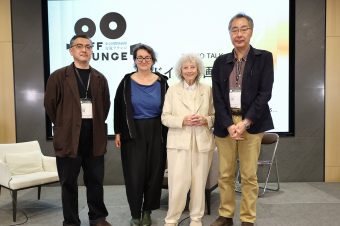
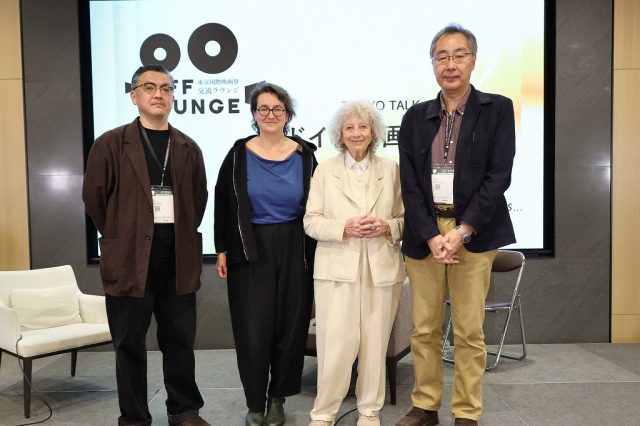
From left: Morita Yuichi (Punkte LLC), Barbara Wurm (Head of the Berlinale Forum at the Berlin International Film Festival), Ulrike Ottinger (Film Director) and Shibutani Tetsuya (Professor, College of Humanities and Sciences, Nihon University)
From left: Morita Yuichi (Punkte LLC), Barbara Wurm (Head of the Berlinale Forum at the Berlin International Film Festival), Ulrike Ottinger (Film Director) and Shibutani Tetsuya (Professor, College of Humanities and Sciences, Nihon University)
Professor Shibutani Tetsuya, who teaches at Nihon University and specializes in German film, led a robust roundtable discussion, Tokyo Talk: An Evening of German Cinema, on November 1 at the 39th Tokyo International Film Festival, and began by pointing out that film festivals can’t help but exemplify the idea that cinema is becoming more globalized. “It’s often impossible to describe a film simply as belonging to one country,” he said. But because the discussion was meant to cover the films labeled “German” at this year’s TIFF, Shibutani began by considering what makes a film “German.”
Though the history of German cinema reaches back to the beginning of the 20th century, he explained, what moviegoers in Japan think of when they think of it is the New German Cinema that evolved after World War II and “emerged at a time when the German film industry was in decline and much of its output consisted of undistinguished comedies and pornography.”
The German filmmakers who resisted these “commercial priorities” at first occupied the margins of the industry, but quickly became known internationally through film festivals, where their diversity and attention to social issues were prominent. This movement started losing steam in the 1980s after the death of perhaps its most prolific director, Rainer Werner Fassbinder. As the political winds changed in West Germany, so-called auteur cinema was pushed aside until after reunification, when films became more varied in tone and subject matter due to the more diverse backgrounds of filmmakers, including immigrants from other countries whose parents had come to Germany as “guest workers,” such as the celebrated Turkish-German director Fatih Akin.
In addition, said Shibutani, filmmakers from the former East Germany provided a counterpoint to the “capitalist system of the West and began making films rooted in their experiences.” Moreover, “a new generation of women filmmakers emerged,” thus adding to the diversity of the national cinema culture in the 21st century.
These changes have affected how Germans view their troubled history. “As time passes,” said Shibutani, “people who experienced war firsthand are disappearing. Japan, too, was a participant in the war, so this is hardly an issue unique to Germany. What happens when people without direct experience make films that equate Germany with Nazism and the Holocaust? Those subjects can also become commercial material, and the question of how to handle them is difficult.”
Such historical matters remain sensitive for German filmmakers, as are questions surrounding Israel, since “criticizing the State of Israel [is difficult] because of the danger that criticism may be exploited for antisemitic purposes,” said Shibutani.
These factors have thus made German Cinema today very wide-ranging and inclusive of many viewpoints, and Shibutani pointed to certain titles at this year’s TIFF that illustrated this variety. The German contingent is represented mainly by women directors, with Valeska Grisebach’s The Dreamed Adventure, Angela Schanelec’s My Wife Cries and Isabelle Stever’s I Rarely Wake Up Dreaming as films representative of a wider, more worldly sensibility.
“The attraction of New German Cinema has never entirely disappeared,” said Shibutani, before introducing veteran German filmmaker Ulrike Ottinger, whose Berlin Trilogy is a classic of the movement. The fact that she is still active, and presenting her latest film, The Blood Countess, at this year’s TIFF, is a testament to her endurance and relevance. “Her work has also taken her across Europe and to East Asia,” Shibutani pointed out. “Under Snow, which was made in Japan, is another film screening at the festival.”
Ottinger then discussed her career with Morita Yuichi, who works for Punkte LLC, the company that has brought some of Ottinger’s films to Japan. Noting that this was her sixth trip to Japan, she enthused about being able to see restorations of two Japanese classics, Mizoguchi Kenji’s The Water Magician (1933) and A Story from Chikamatsu (1954). “I was completely captivated [by The Water Magician]—by the film itself, but also by the relationship between the musical accompaniment, the spoken voice and the images.” She cited several German critics who have devoted their careers to writing about Japanese cinema and said that while living in Paris in the 1960s, she “often watched Japanese films at the Cinémathèque. I find it formally fascinating, including its relationship to theater, but also its treatment of the major social transformations after World War II.”
She went on to talk about Under Snow (2011), her documentary about kabuki performances in Niigata Prefecture, a region that is known as “snow country” because of its heavy winter precipitation. Inspired by a book by Suzuki Bokushi, she became “fascinated by the people who live under the snow and with the snow. Despite these difficulties, they are extraordinarily inventive. They find ways to create a rich life and a culture of their own,” building kabuki stages out of snow, and even setting up markets on “tables made of snow.”
Ticket of No Return (1979), the first installment in Ottinger’s Berlin Trilogy, is also being screened at the 39th TIFF. “I first went to Berlin in 1973,” recalled Ottinger, “after having lived in Paris. I had known West Germany, with its beautiful medieval towns. I arrived in Berlin and could hardly believe that such a city existed in Germany.” The film, a sardonic look at addiction and the moral arguments surrounding addictive behavior, traces the adventures of a rich woman who decides to drink herself to death in Berlin. Ottinger said the city, with its “beer gardens among the ruins” of World War II, directly inspired the script.
Similarly, Vienna was the inspiration for her latest film, The Blood Countess, a black satire about vampirism as a metaphor for empire. “The Habsburgs had an extraordinary enthusiasm for rituals surrounding death,” she said. “All these things inspired me, and that is why I chose the vampire genre.”
Morita recalled seeing the film at its premiere at the Berlin International Film Festival in February. “There were bursts of laughter,” he said, “with people even clapping as they laughed. In Berlin I also saw a local magazine with you on the cover. It made me realize how loved and respected you are in Germany.”
Ottinger said, “As you grow older, critics perhaps become a little less inclined to take issue with you. You acquire a certain seriousness in their eyes. I find it rather amusing.”
She was certainly amused by the laughter. “I consider myself very much an outsider in German Cinema. I don’t make psychological dramas. I work through a cinema of images, in which everything is told through the images themselves. The dialogue takes place within the images, among all the different elements in the film.
“You also have this in Japan,” she continued, “where things are depicted in paintings that can be highly stylized. This is the world I come from. I create a world and then I criticize it.”
An audience member asked Ottinger about her casting of the French star Isabelle Huppert in the role of the lead vampire.
“I have worked with well-known actors before,” she replied. “This was the cast I wanted for The Blood Countess. I have known Isabelle Huppert for 20 years and had long wanted to work with her. Actors take great pleasure in doing something different. What I need are performers who can do that, who can work in another way.”
Another audience member asked about the costumes and production design, which are quite elaborate.
“This was the most expensive film I’ve ever made,” said Ottinger. “We had a crew of more than a hundred, which is what really made it expensive. I would have preferred working with 50 good people—I mean, everyone on this film was very good, but I prefer smaller groups who can work more closely together.” She mentioned that the exacting nature of the set designs also boosted the budget considerably, “which is why I no longer produce my films myself.”
The Japanese writer Tawada Yoko, who lives in Berlin, was mentioned, since she was involved in Under Snow. Ottinger revealed that she expressly wanted Tawada to be involved in the film “as a mediator, not only linguistically, but culturally.” Consequently, Tawada became her liaison with the communities she filmed in Niigata. She also participated in the shoot.
Apparently, they had become acquainted by working on a play by Johann Nepomuk Nestroy together in Berlin in 1999. Tawada translated the play into three forms of Japanese—contemporary speech, classical diction suitable for kabuki, and a script that explained its historical context—when it was brought to Kyushu to be performed at a festival. “I thought that was quite remarkable,” added Ottinger. She also pointed out that two of the kabuki actors who performed at the festival also performed in Under Snow.
Morita asked how she came upon the book that inspired the film, Hokuetsu Seppu (1837/1841), which he had never read. Ottinger replied she found a translation in a secondhand bookstore. “It was translated by a German woman who was married to a Japanese man.” Tawada later found an original edition of the book and gave it to her as a gift.
Another audience member mentioned the French actor and filmmaker Delphine Seyrig, with whom Ottinger has worked. A documentary by Seyrig, Be Pretty and Shut Up (1981), has just been released in Japan for the first time, and the questioner wondered about their shared views on feminism.
Ottinger said that while living in Paris she met Seyrig at a women’s film festival in Brussels. “She was already a major figure in French cinema,” said Ottinger, “and I was completely unknown. But she came up to me and said she would work with me anytime.”
“We discussed everything that mattered at the time,” she continued, “politically and socially.” She pointed out that she made the last film that Seyrig was in, Joan of Arc of Mongolia (1989).
Another question concerned the singer Nina Hagen, who appeared in Ticket of No Return. Did Ottinger have a punk rock affinity?
Ottinger noted that Hagen actually had an “extraordinary musical training” even though she is categorized as punk. “Punk to me simply means trying something—sometimes it works and sometimes it doesn’t. But Nina Hagen is someone who can really do it.”
After Ottinger left the dais, the next guest of the evening was Barbara Wurm, who has been in charge of the Berlinale Forum of the Berlin International Film Festival since 2023. Her task at the Tokyo Talk was to “discuss developments she has observed in German cinema through her work.”
Wurm complimented Shibutani on his overview of postwar German cinema, using it as a launching pad from which to discuss the globalization of cinema from the 1990s onward. German cinema, taken as a national cinema, perfectly embodies the idea of a cinema industry that crosses borders in ways that are not exclusively economic.
“Consider Mohammad Rasoulof, the Iranian director,” she said. “His film was submitted by Germany for last year’s Oscar race for Best International Film. Or Ilker Çatak, a German filmmaker with a Turkish migrant background, whose Yellow Letters (2026) won the Berlinale’s top prize. Such developments are not simply the result of recent migration, including migration caused by war. There is a much longer tradition extending back to the 1960s of filmmakers from other countries receiving their training in Germany. It began even earlier in East Germany, which had an agreement with Vietnam in the 1950s.”
West Germany in the 1960s started accepting guest workers from Turkey, as well as refugees from conflicts in the former Yugoslavia, some of whom settled and became filmmakers. “Tragically, over the years,” she added, “people have repeatedly arrived from Iran.” She called the relationship between Iranian filmmakers and Germany “an established connection in its own right.” In the Forum, she has seen this connection up close with works in Farsi of extraordinary depth, and she “unhesitatingly” calls these directors German filmmakers.
But while German cinema has gained much in this globalization process, it has also lost many central figures in recent years, including Rosa von Praunheim, Thomas Heise and Alexander Kluge. “The loss of that generation has left an enormous gap,” she said.
Professor Shibutani noted that Iranians have been making movies in Germany since the 1970s, when New German Cinema was still at its peak. These directors should be discussed in tandem with the New German Cinema masters, he felt: “I would like to see a new map of that history.”
TIFF Lounge -TOKYO TALK-
TOKYO TALK:An Evening of German Cinema
Guests:
Ulrike Ottinger (Film Director), Barbara Wurm (Head of the Berlinale Forum at the Berlin International Film Festival) and Shibutani Tetsuya (Professor, College of Humanities and Sciences, Nihon University)
Interviewer: Morita Yuichi (Punkte LLC)
Moderator: Kondo Kanako (Programming Group, 39th Tokyo International Film Festival)
World Focus Tribute to Ulrike Ottinger
The Blood Countess
Under Snow
Ticket of No Return
Related Article: TIFF’s Exclusive Interview with Ulrike Ottinger














Recent News